

SynaCare
The hospital OS where AI moves first.
Hospital scale rather than clinic scale: registration through discharge, lab bench through general ledger. Built on the premise that AI is the operating layer rather than a module bolted on, so every workflow asks what can be handled before a human has to act.
- API modules
- 82API modules
- frontend modules
- 61frontend modules
- AI engines
- 14AI engines
- database tables
- 200+database tables
The problem
Hospital software splits badly in two. Enterprise systems cost millions and take a year or more to put in, and the hospital ends up renting its own processes back. The open-source alternatives are honest but dated: no AI, interfaces built for a different decade, and whole departments left to spreadsheets.
Where AI does appear it is bolted on — a separate licence, a separate integration, a separate training day. Interoperability gets the same treatment, so hospitals pay again for HL7 and FHIR work that should have been there from the start.
What we built
SynaCare runs the whole hospital: registration through discharge, lab bench through general ledger. It was built on one premise — that AI is the operating layer rather than a module — so every workflow asks what can be handled before a human has to act.
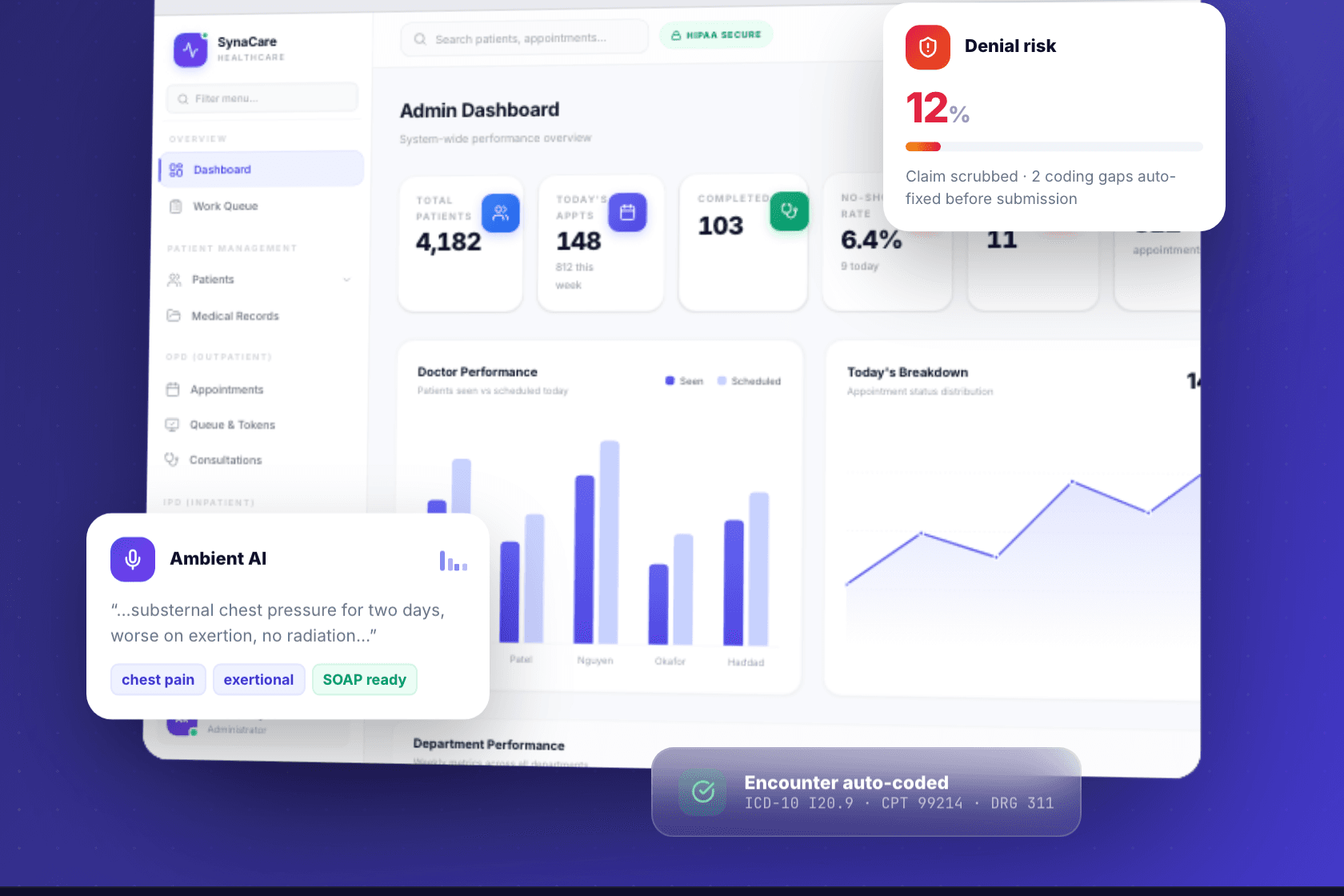
Ambient documentation turns a spoken consultation into a structured note. Encounters are auto-coded with the codes shown rather than hidden. Claims are scrubbed and scored for denial risk before submission, not after rejection.
Built to actually go in
FHIR R4, HL7v2 and SMART on FHIR are native, so the hospital is not buying an integration project alongside the system. HIPAA controls are on by default rather than a configuration step someone has to remember.
It ships as Docker Compose, so a hospital can stand it up on its own hardware rather than waiting on a procurement cycle. Six languages including right-to-left layouts, a React Native app, and a WhatsApp bridge that handles booking and queue status where patients already are.
A closer look
What it actually does.
One dashboard over eighty-two modules
Total patients, today's appointments, completions, no-show rate and department performance on one view — and beside them the things AI already handled: a consultation transcribed and entity-tagged into a SOAP note, an encounter auto-coded with its ICD-10, CPT and DRG shown rather than hidden, and a claim scrubbed with two coding gaps fixed before submission.
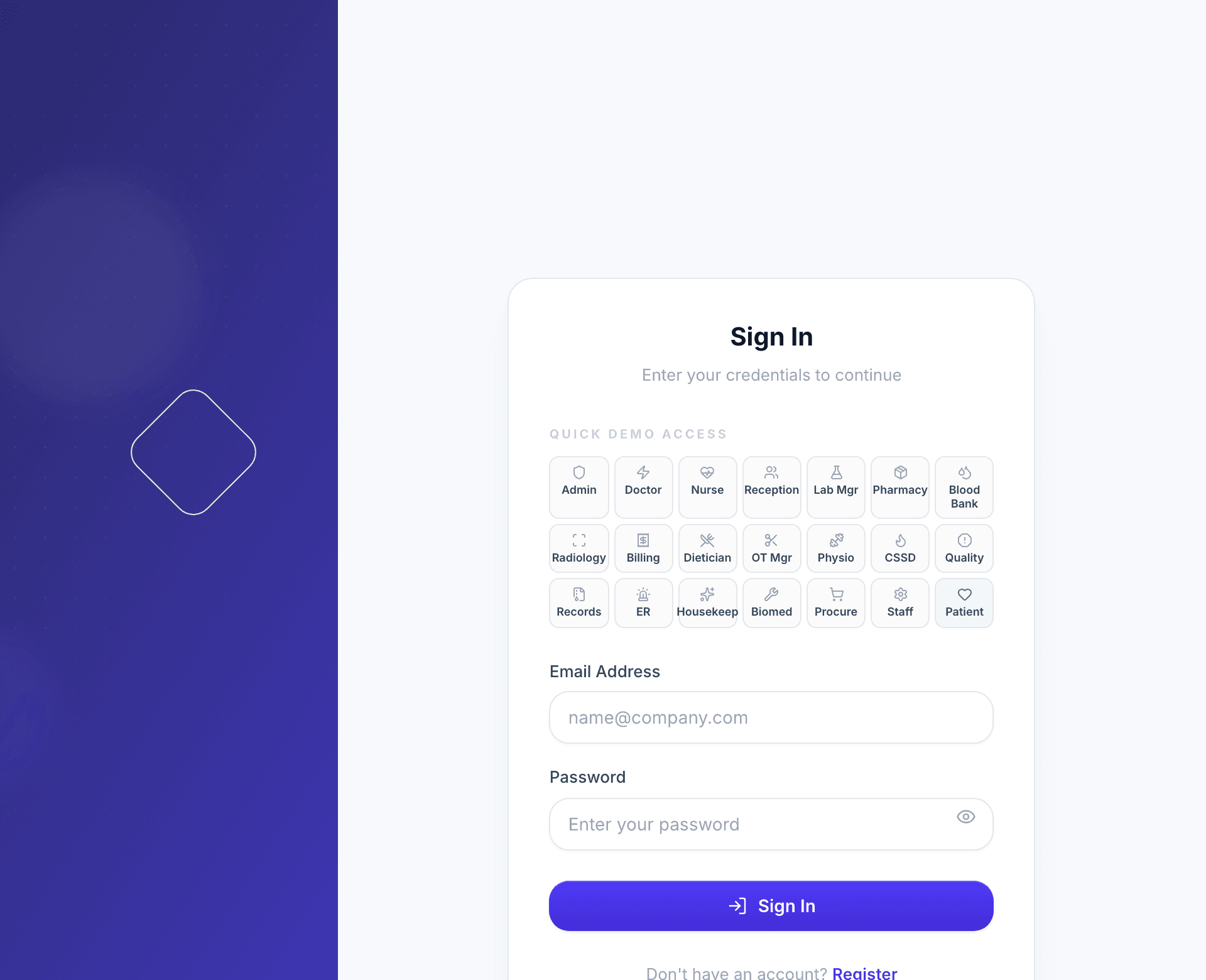
Twenty-one roles, and the demo opens in any of them
A hospital is not one user. Admin, doctor, nurse, reception, lab manager, pharmacy, blood bank, radiology, billing, dietician, theatre manager, physio, CSSD, quality, records, ER, housekeeping, biomedical, procurement, staff and patient each get their own surface over the same record. The demo exposes all of them as one-click entry, because the fastest way to evaluate a hospital system is to stand in the role you actually work in.
Interoperability that was not sold separately
FHIR R4, HL7v2 ADT and SMART on FHIR are part of the system rather than an integration project quoted alongside it. That matters at the point a hospital connects a lab analyser, a PACS or a national exchange — the work is configuration, not a second procurement.
What is in it
The parts that do the work.
- 82 API modules under 61 frontend modules and 200+ database tables — OPD, emergency, wards, theatre, pharmacy, lab, radiology, billing and back office
- 14 AI engines embedded in the workflow rather than sold as an add-on: ambient documentation, auto-coding, denial-risk scoring, triage
- Native FHIR R4 and HL7v2 interoperability, plus SMART on FHIR
- HIPAA controls on by default, not a configuration step
- Multi-tenant SaaS, six languages including right-to-left layouts
- A React Native mobile app and a WhatsApp bridge for patient booking and queue status
- React 19, FastAPI, Postgres 16 and Redis 7, shipped as Docker Compose so a hospital can run it on its own hardware
Built on
- FastAPI on Python, 82 API modules
- React 19 with 61 frontend modules
- Postgres 16 and Redis 7
- React Native mobile app
- WhatsApp bridge for patient booking
- Docker Compose, self-hosted
Try it