Every field-service business runs the same losing negotiation with its technicians. The job is done, the van is loaded, the next site is twenty minutes away — and somebody wants a form filled in. So the report gets written in the truck at 7pm, or on Friday for the whole week, or never.
Voice to text job reports flip the deal. The technician talks for thirty seconds. The system does the paperwork. Not a transcript dumped into a notes field — a structured report with the client, the parts consumed, the customer's mood, and the next action, each in its own field, ready to invoice against.
Here is how that works, and where it goes wrong.
What the delay actually costs
The missing report is rarely the real problem. What it holds up is:
- Invoicing. Parts and labour cannot be billed until somebody writes down what was used. Reports that lag three days lag the cash by three days.
- Parts reconciliation. Stock walks out of the van and nothing records it. The variance shows up at inventory count, months from the job that caused it.
- Follow-ups. "Customer was annoyed about the wait, flag for follow-up" lives in one technician's memory until it doesn't. That is a churn event nobody logged.
- Anything resembling reporting. Free-text notes cannot be counted. You cannot see which parts fail most, which sites eat time, or which accounts are souring.
Note that all four are business problems, not documentation problems. That is the case for fixing it.
The pipeline: three stages
Ingest. The technician records in the browser on their phone, or uploads a file. Two hard requirements the demos always skip: it must work on a bad connection — queue locally, upload when signal returns — and it must survive being used one-handed in a noisy plant room.
Transcribe. Speech to text, which is the easy stage now, with two exceptions covered below.
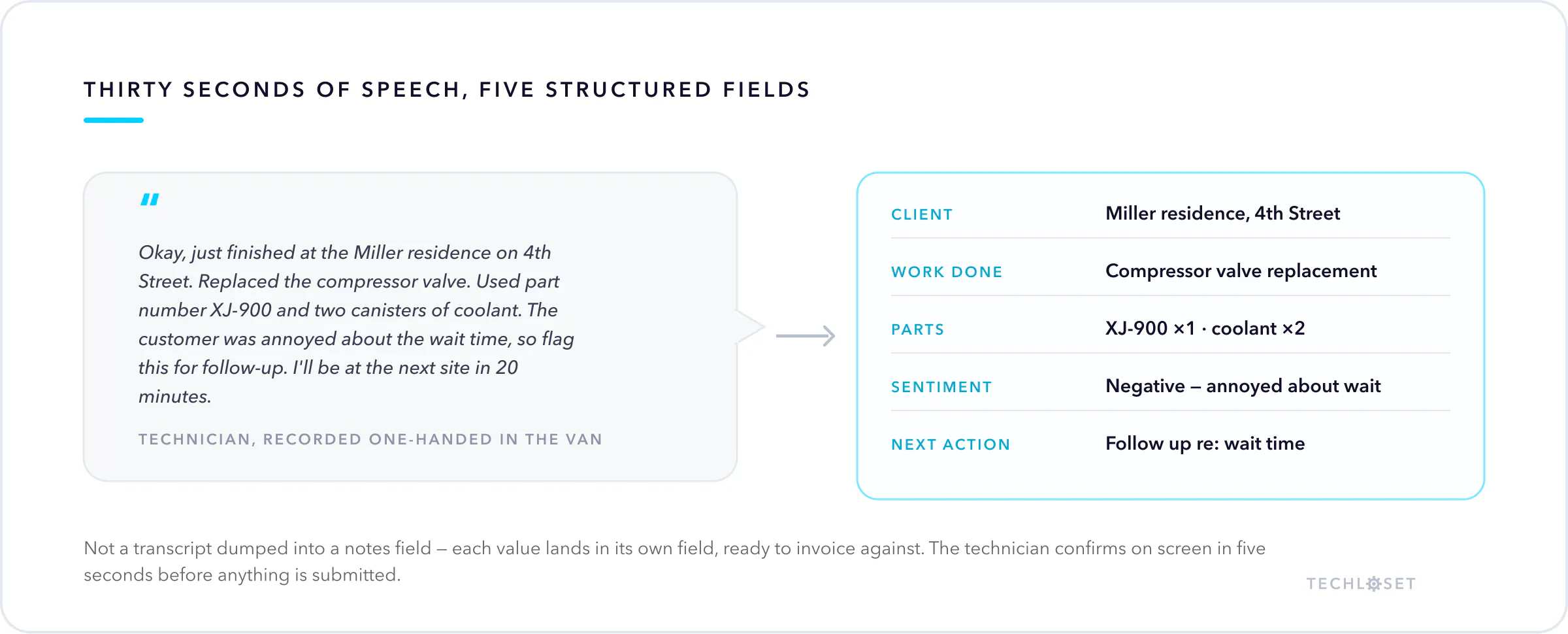
Extract. A language model reads the transcript and returns structured fields. Given this real note:
"Okay, just finished at the Miller residence on 4th Street. Replaced the compressor valve. Used part number XJ-900 and two canisters of coolant. The customer was annoyed about the wait time, so flag this for follow-up. I'll be at the next site in 20 minutes."
The output should be: client Miller residence, 4th Street · work done compressor valve replacement · parts XJ-900 ×1, coolant ×2 · sentiment negative · next action follow up re: wait time. Five fields, one rambling sentence, no typing.
The four things that break
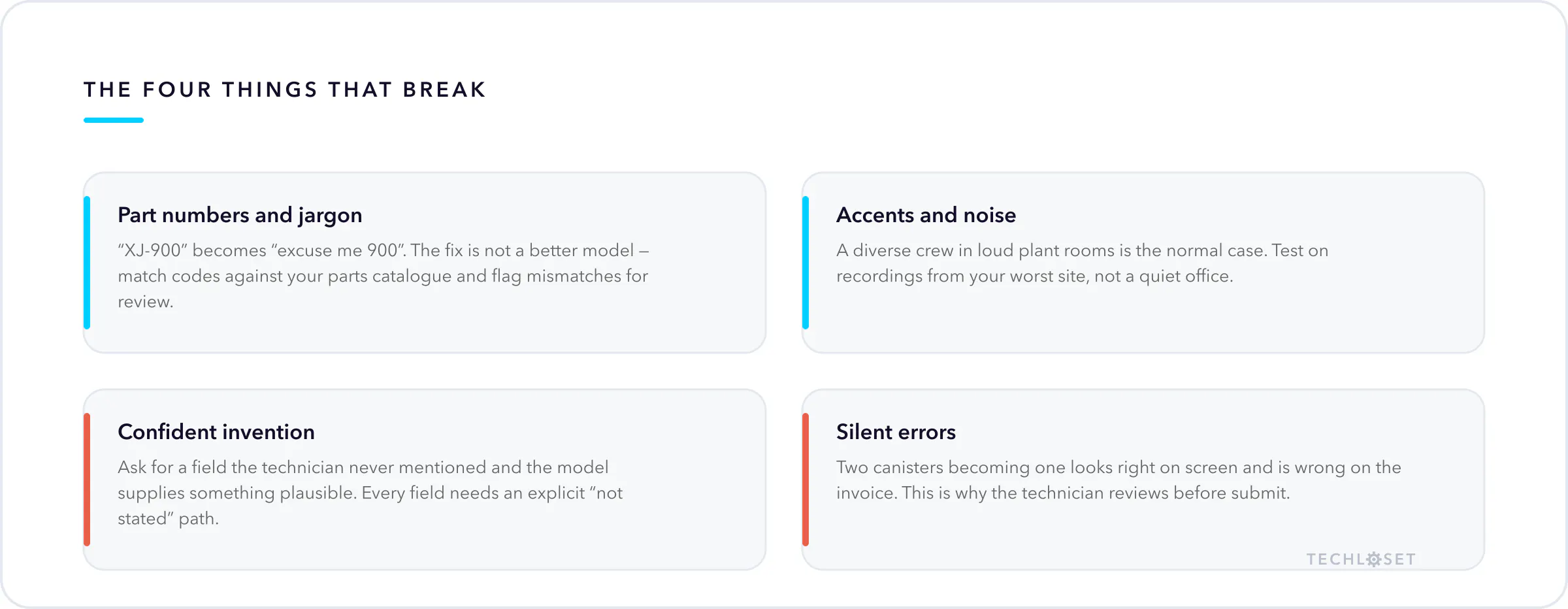
Part numbers and jargon. "XJ-900" is where generic transcription fails — alphanumeric codes get mangled into "XJ nine hundred", "XJ900", or "excuse me 900". The fix is not a better model, it is constraining the output: match extracted codes against your actual parts catalogue and flag mismatches for review rather than guessing.
Accents and noise. A diverse crew in loud environments is the normal case, not the edge case. Test on recordings from your worst site, not a quiet office.
Confident invention. Ask a language model for a field the technician never mentioned and it will often supply something plausible. Every field needs an explicit "not stated" path, and the extraction must be traceable to the words that produced it.
Silent errors. The genuinely dangerous failure is a wrong quantity that looks right. Two canisters becoming one is invisible on screen and wrong on the invoice.
Which leads to the single most important design decision: the technician reviews before submit. Extracted fields shown on screen, tappable to correct, five seconds to confirm. It keeps a human accountable for what gets billed, and every correction is training data telling you exactly which field is weakest.
What structure unlocks
Once reports are fields instead of prose:
- Same-day invoicing, because the billable line items already exist.
- Parts usage that reconciles, because consumption is logged at the job.
- Sentiment as an early warning. Negative flags routed to a manager the same afternoon are a retention system. The value is not the classification, it is that somebody sees it in time.
- Next actions that become tasks, assigned and dated, rather than intentions.
- Patterns you can act on — recurring faults, sites that always overrun, parts that fail early.
Build notes
Keep it a web app, not a native install — field crews change, devices vary, and nobody is onboarding a new hire through an app store. Record in the browser, queue offline, sync when connected.
For extraction, a hosted model API is the pragmatic choice: define the output schema explicitly, validate every response against it, and reject rather than repair malformed output. Log the transcript alongside the extracted fields permanently — when an invoice is disputed, the audio is the record.
Start with five fields, not twenty-five. Every field added is another thing to get wrong and another second of review. Ship the five that block invoicing, then earn the rest.
FAQ
How long does a technician actually spend? Thirty seconds talking, five seconds confirming. If review takes longer than the recording, the schema is too big.
What about privacy? Voice recordings can carry customer names, addresses, and property details. Encrypt at rest, set a retention policy, and restrict playback access. If a hosted model API processes transcripts, that is a data-processing relationship to paper properly.
Can it work in more than one language? Yes — modern speech models handle mixed-language crews well, though extraction quality varies by language. Validate per language rather than assuming parity.
Does this only suit field service? The pattern — messy speech in, structured record out — works anywhere a busy person is meant to file a report and doesn't. The clinical version of it is the AI medical scribe, same architecture, much stricter accuracy bar.
The short version
Technicians will not become typists, and no amount of process discipline changes that. Move the reporting burden onto a thirty-second voice note, extract the fields that block money, and let a human confirm rather than compose.
We build these systems where the accuracy bar is real — catalogue-validated extraction, offline capture, human review before anything becomes an invoice. If your reports are arriving days late, book a call and bring one week of them. We will tell you which fields are worth automating and which are noise.


