The front desk is the least suitable place in a practice for the most consequential decision it makes. A receptionist with three lines ringing and a queue in front of them is deciding, informally and constantly, who needs to be seen today.
AI medical triage moves that first sort earlier. A patient describes what is wrong, in chat or by voice, and the system establishes urgency, routes accordingly, and books where booking is right. Staff get a queue that is already ordered. Patients get an answer at 11pm instead of at nine the next morning.
It is also the most safety-critical software in this category. So the architecture below leads with what stops it from causing harm, because that is what makes the rest of it deployable.
What it is for
Four jobs, in order of value:
- Sorting urgency. The genuinely urgent presentation surfaces immediately instead of waiting in arrival order. This is the entire point.
- Reducing front-desk load. Routine requests self-serve. Staff handle the ones that need a human.
- Answering out of hours. Most patient uncertainty happens when the practice is closed, and voicemail is a poor response to "should I be worried about this?"
- Capturing structure. What the patient reported, when, and what they were told — recorded before the visit rather than reconstructed during it.
The flow
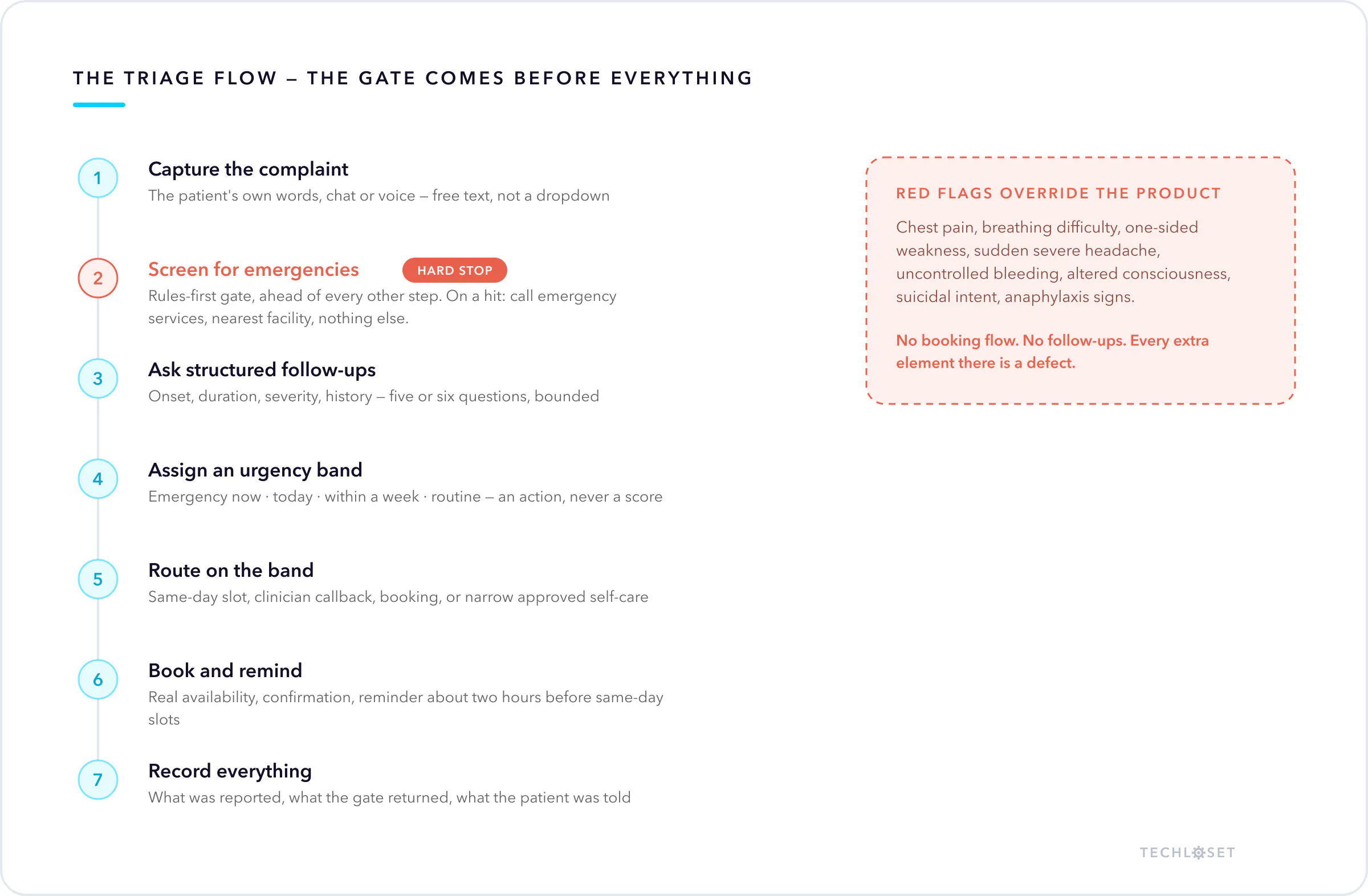
1. Capture the complaint in the patient's own words, chat or voice. Free text, because a dropdown cannot express "it started after dinner and now it's spreading to my arm."
2. Screen for emergencies — before anything else. This is a rules-first gate, not a model judgement, and it runs ahead of every other step. Chest pain, breathing difficulty, one-sided weakness or facial droop, sudden severe headache, uncontrolled bleeding, altered consciousness, suicidal intent, anaphylaxis signs. When any of these hit, the product stops. It says call emergency services now, gives the nearest emergency facility, and offers nothing else — no booking flow, no follow-up questions, no "you may also want to consider". Every extra element there is a defect.
3. Ask structured follow-ups for everything that clears the gate. Onset, duration, severity, progression, relevant history. Bounded — five or six questions, not an interrogation. Patients abandon long forms, and an abandoned triage is a patient who learned nothing.
4. Assign an urgency band with an action attached. Emergency now · today · within a week · routine. Bands, never a numeric score, because "6.5" means nothing to a worried person at midnight while "you should be seen today" is actionable.
5. Route on the band. Emergency to emergency services. Today to a same-day slot or a callback from a clinician. Within a week to booking. Routine to booking, or to self-care guidance — with the limits in the next section.
6. Book and remind. Real availability, real calendar, confirmation, and a reminder ahead of the appointment — around two hours out works well for same-day slots. The booking mechanics are here.
7. Record everything. What was reported, what the gate returned, which band, what the patient was told, what they did. This is clinical context for the visit and your audit trail if a decision is ever questioned.
The safety architecture
Six properties. A triage product missing any of them should not ship.
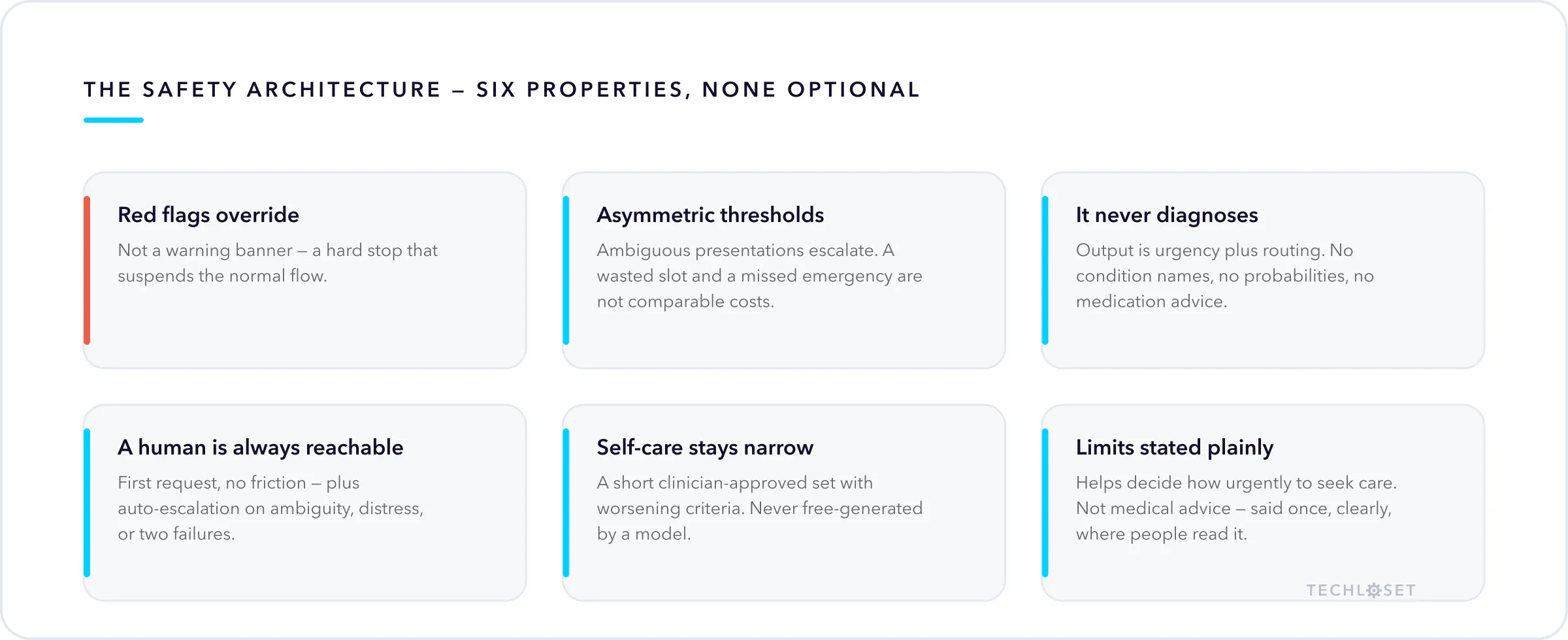
Red flags override the product. Not a warning banner — a hard stop that suspends normal flow.
Asymmetric thresholds. When a presentation is ambiguous, escalate. An unnecessary same-day appointment costs a slot; a missed urgent presentation is not comparable, and the thresholds should visibly reflect that asymmetry.
It never diagnoses. Output is urgency plus routing. Never a condition name, never a probability of disease, never medication advice — not even over-the-counter dosing. Specialty routing is a separate concern, and both stop short of diagnosis.
A human is always reachable. First request, no friction, no retention attempt. Plus automatic escalation on ambiguity, distress, or two failures to understand.
Self-care guidance is narrow and conservative. This is the riskiest feature in the product. Limit it to a short, clinician-approved set of clearly minor conditions, always paired with explicit worsening criteria and a "if any of this changes, contact us" instruction. Never generated freely by a model. If you cannot get a clinician to sign off on the exact wording, it does not ship.
Limits stated plainly, where people read them. This helps decide how urgently to seek care. It is not medical advice and not a diagnosis. Once, clearly, not buried in a terms page.
What to leave out
- Diagnosis. Different product, different regulatory class, far worse risk profile.
- Medication advice, including OTC.
- Talking anyone down. A system that reduces demand by discouraging care is not efficiency, it is harm with a dashboard.
- Free-form clinical chat. Every clinical response comes from an approved set. An open-ended model discussing symptoms will eventually say something indefensible, fluently.
What to measure
- Under-triage rate — patients banded too low who turned out to need urgent care. The number that matters most, and the one vendors do not volunteer. Audit it continuously against outcomes.
- Over-triage rate — the cost side, worth watching but never optimised at the expense of the above.
- Containment — share of contacts resolved without staff involvement.
- Escalation latency — how fast a red flag reaches a human.
- Abandonment — where patients drop out of the flow, which tells you where it is too long.
FAQ
Is it regulated? Depends on claims and jurisdiction. Urgency guidance sits in a different, lighter category than diagnosis, which is one of several good reasons to stay on the urgency side. Get regulatory advice for your market before launch, not after.
Will patients trust it? More than expected for logistics, less for anything feeling like a diagnosis. Trust holds when it is clear about what it is and instantly hands over on request.
Voice or chat? Both, and they behave differently. Voice reaches people who will not use a form and is harder to get right — latency and interruption handling become critical. Chat is easier and leaves a cleaner record.
Does it reduce ER visits? It can route non-emergencies to appropriate care, which is where that benefit comes from. Be sceptical of vendor percentages and measure your own.
Who signs off on the clinical logic? A clinician, in writing, with a review cycle. This is not a product decision.
Where to start
Red-flag screening first, on its own, doing nothing but detecting and escalating. Get that audited and signed off. Then urgency banding. Then booking. Then, only if genuinely warranted, a small approved self-care set. Teams that build the conversational flow first and add safety later ship the risk and retrofit the controls.
This is the front door of a system that should cover every channel — the same engine behind our AI receptionist work. If your front desk is triaging informally between phone calls, book a call and we will start with the red-flag path.


