Most hospital software succeeded at one thing: it moved the paperwork onto screens. The forms are digital, the records are searchable, and the handoffs between departments are exactly as manual as they were on paper. Somebody still walks the request over. Somebody still re-enters the same details into the third system.
An AI hospital management system is meant to remove those handoffs rather than digitise them. That is a real and large distinction, and it is also where most vendor claims collapse into a feature list. Here is what actually changes, what should not be automated, and why the migration is harder than the build.
The problem is the seams, not the modules
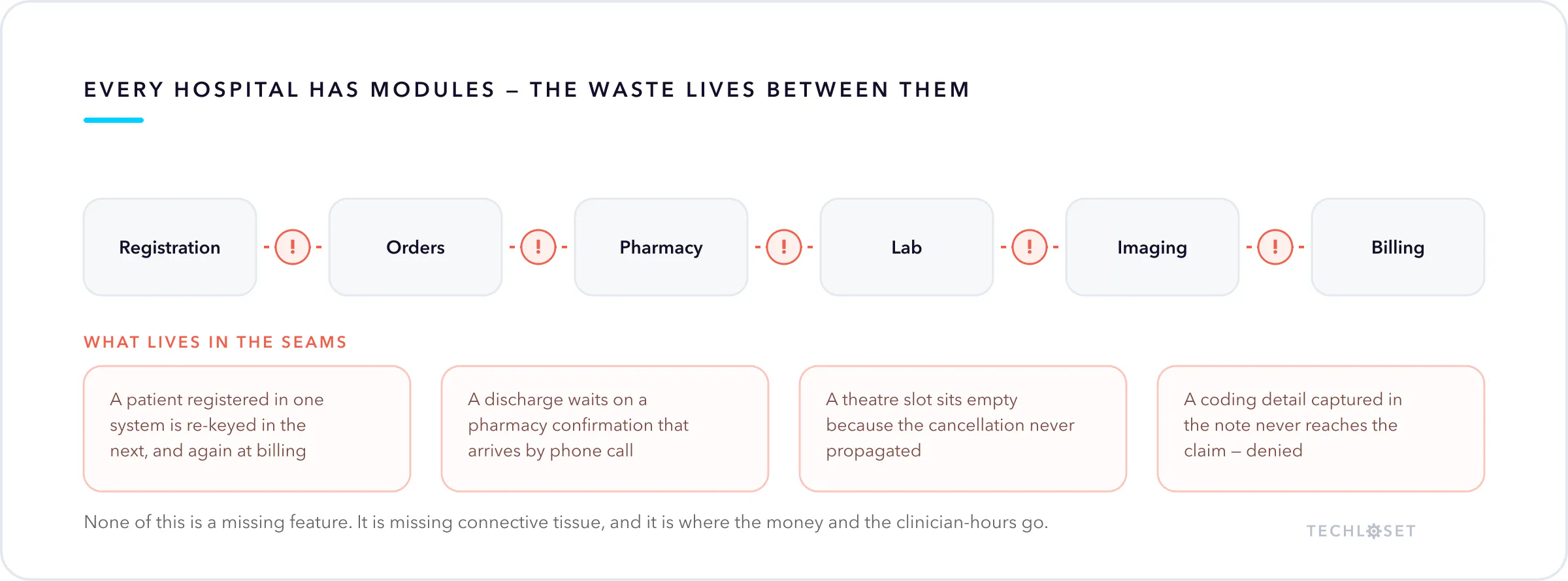
Every hospital already has modules. Registration, orders, pharmacy, lab, imaging, billing, inventory — they exist. The waste lives between them:
- A patient is registered in one system, re-keyed in the next, and re-keyed again at billing.
- A discharge waits on a pharmacy confirmation that arrives by phone call.
- A theatre slot sits empty because the cancellation never propagated to scheduling.
- A claim is denied for a coding detail that was captured in the clinical note but never made it to billing.
- Inventory reorders on a fixed schedule rather than on consumption, so the blood bank and the supply room both run on somebody's memory.
None of that is a missing feature. It is missing connective tissue, and it is where the money and the clinician-hours go.
What "AI-first" should mean
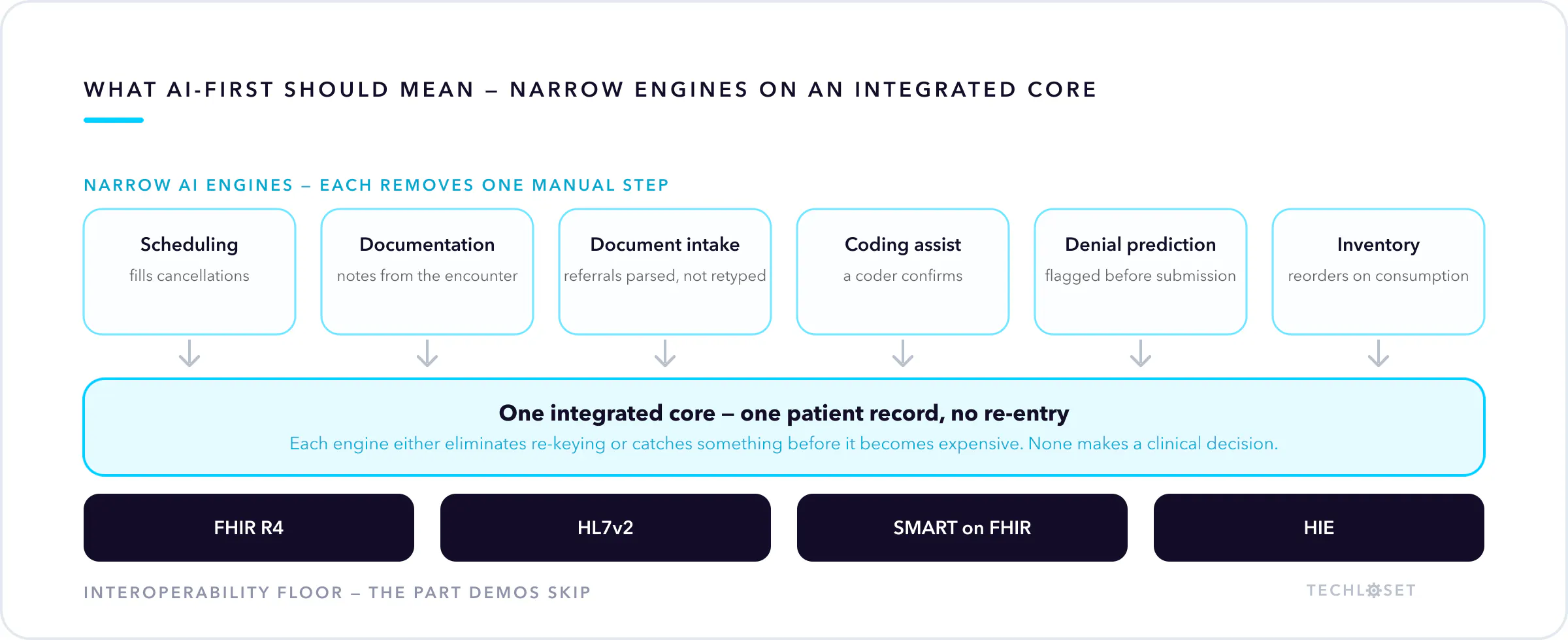
Not a chatbot bolted onto a login screen. The useful version is a set of narrow engines sitting on top of a properly integrated core, each removing a specific manual step:
- Scheduling optimisation — filling cancellations, sequencing theatre lists, balancing clinic load against staffing rather than against a template.
- Documentation — clinical notes generated from the encounter instead of typed after it. How ambient scribing works.
- Document intake — referrals, outside results and insurance details parsed into structured fields rather than retyped. The extraction pipeline.
- Coding assistance — surfacing the codes a documented encounter supports, for a coder to confirm.
- Denial prediction — flagging claims likely to be rejected before submission, when fixing them is cheap.
- Inventory forecasting — reorder points driven by actual consumption patterns, including the seasonal ones nobody models by hand.
- Triage support at the front door. Covered separately.
The pattern across all of them: each one either eliminates re-entry or catches something before it becomes expensive. None of them makes a clinical decision.
Interoperability is the whole ballgame
A hospital system that cannot exchange data is a silo with a nicer interface, and this is where serious platforms separate from demos.
- FHIR R4 for modern resource-level exchange — patients, encounters, observations, orders, reports.
- HL7v2 because the installed base runs on it and will for years. Any platform that only speaks FHIR cannot connect to the lab analyser you already own.
- SMART on FHIR so applications launch in context inside the clinician's existing workflow rather than as another tab.
- HIE connectivity for records that follow the patient between organisations.
If a vendor cannot answer interoperability questions in specifics, the integration cost lands on you after signature. Ask which HL7v2 message types, which FHIR resources, and which profiles.
Architecture decisions that matter later
Multi-tenancy is worth the cost if you run more than one facility or intend to. Retrofitting tenant isolation into a single-tenant schema is close to a rewrite, and the security review will find it.
Multi-language with real RTL support is not a translation file. Right-to-left layout affects component structure, iconography, date and number formatting, and printed output. Teams that treat it as a late-stage string swap rebuild their UI.
HIPAA in every layer, not at the perimeter. Encryption in transit and at rest, role-based access enforced at the data layer rather than the UI, immutable audit logging of every read and write, BAAs with every processor including model providers. A firewall around a permissive core is not compliance.
Mobile as a first-class client, because clinicians round on their feet. A responsive desktop layout is not the same product.
What not to automate
Worth stating plainly, because enthusiasm here creates risk:
- No autonomous clinical decisions. Systems suggest, rank, draft and flag. Clinicians decide and sign, and the signature is recorded.
- No auto-submitted claims. Prediction and flagging, yes. Submission without human sign-off turns a model error into a compliance event.
- No auto-resolved alerts. Every flag needs an accept or override, and every override needs to be logged. Without the override trail you cannot audit or improve the system.
- No silent thresholds. Whoever owns the workflow owns the threshold, and they need to see it.
The migration is the hard part
The build is bounded. The migration is not, and it is where these programmes actually fail.
Data migration from systems whose data is messier than anyone documented — duplicate patients, free-text fields holding structured data, historical records with no clean mapping. Budget for reconciliation and expect to run parallel for a period.
Change management matters more than features. Staff who have worked around the old system for a decade have undocumented processes that are load-bearing. Find them before go-live.
Phased rollout, always. One department, stabilise, next. Big-bang cutovers in hospitals fail in ways that affect patients.
FAQ
How long does an HMS implementation take? Months to years depending on scope and how many legacy interfaces exist. Anyone quoting weeks is quoting a module, not a system.
Build or buy? Buy the commodity modules. Build where your workflow is genuinely unusual, or where you are the vendor. The interesting answer is usually a bought core with built integration and AI layers.
Does AI replace administrative staff? In practice it removes the re-entry and the chasing, and redirects those people to work that needs judgement. Vendors promising headcount reduction are selling a business case, not a system.
What is the fastest visible win? Usually documentation or document intake — clinician-facing, measurable in hours, and not entangled in billing rules.
Where we fit
We have built this end of the stack: a hospital platform with 82 backend API modules, 61 frontend modules, 14 AI engines and a native mobile client, with HL7v2, FHIR R4, SMART on FHIR and HIE interoperability, multi-tenant from the schema up, and HIPAA controls at every layer.
If you are scoping an HMS build, replacement, or the AI layer over an existing one, book a call. Bring your interface inventory — that conversation tells us more in twenty minutes than a requirements document does in a month.


