Healthcare still runs on paper that has been photographed. Referrals arrive as faxes. Insurance cards arrive as phone snapshots. Outside lab results arrive as PDFs that were themselves scans of printouts. Somewhere downstream, a human retypes all of it into a system that then treats it as data.
Medical document data extraction removes the retyping. Document in, structured fields out, validated and written into the record. The pipeline is well understood; the part that decides whether it works is not the extraction, it is the validation. That is what this article is mostly about.
Why manual intake is expensive twice
The obvious cost is the hours. The expensive cost is what late or wrong data does:
- Prior authorisations stall waiting on a clinical detail sitting in an un-keyed fax.
- Claims get denied on a mistyped member ID or a date of birth off by a digit — then cost more to rework than they were worth.
- Referrals go cold. A referral that sits unprocessed for four days is a patient who booked somewhere else. That is revenue that was already yours.
- Nothing is queryable. A PDF attached to a chart is storage, not information. It cannot trigger a reminder or populate a report.
The pipeline: five stages
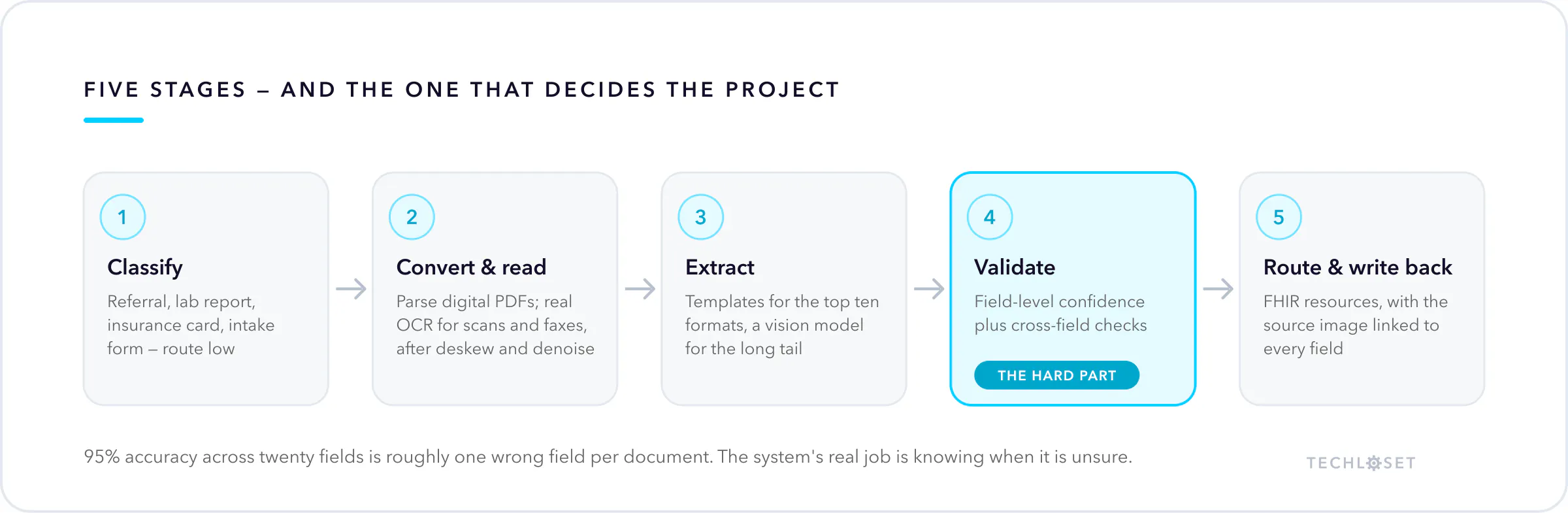
1. Classify. Before extracting anything, identify what arrived. A referral letter, a lab report, an insurance card and an intake form need different field sets. Misclassification poisons everything downstream, so route low-confidence documents to a human rather than guessing.
2. Convert and read. Digital-native PDFs have a text layer — use it, and never OCR what you can parse. Scans and photos need genuine OCR (Tesseract for self-hosted, AWS Textract or Google Document AI for managed), plus deskewing, denoising and contrast correction first. Textract and Document AI understand tables and key-value pairs, which matters more than raw character accuracy.
3. Extract. Two approaches, and the choice is about volume and variety. Template-based extraction is exact and cheap for high-volume documents with a stable layout — one payer's form, your own intake sheet. Model-based extraction using a vision-language model handles arbitrary layouts, which is what you need for the long tail of documents from hundreds of senders. Most real systems run both: templates for the top ten formats, a model for everything else.
4. Validate. Covered below. This is the stage that decides the project.
5. Route and write back. Structured output into the clinical or billing system — FHIR DocumentReference for the source artefact, Observation for discrete results, Coverage for insurance details, ServiceRequest for referrals. Keeping the original image linked to every extracted field is non-negotiable: when a value is questioned, somebody needs to see the source.
Validation is the actual product
An extraction engine that is 95% accurate across twenty fields gets roughly one field wrong on every document. In a clinical or billing context, "mostly right" is not a category that exists. So the system's real job is knowing when it is unsure.
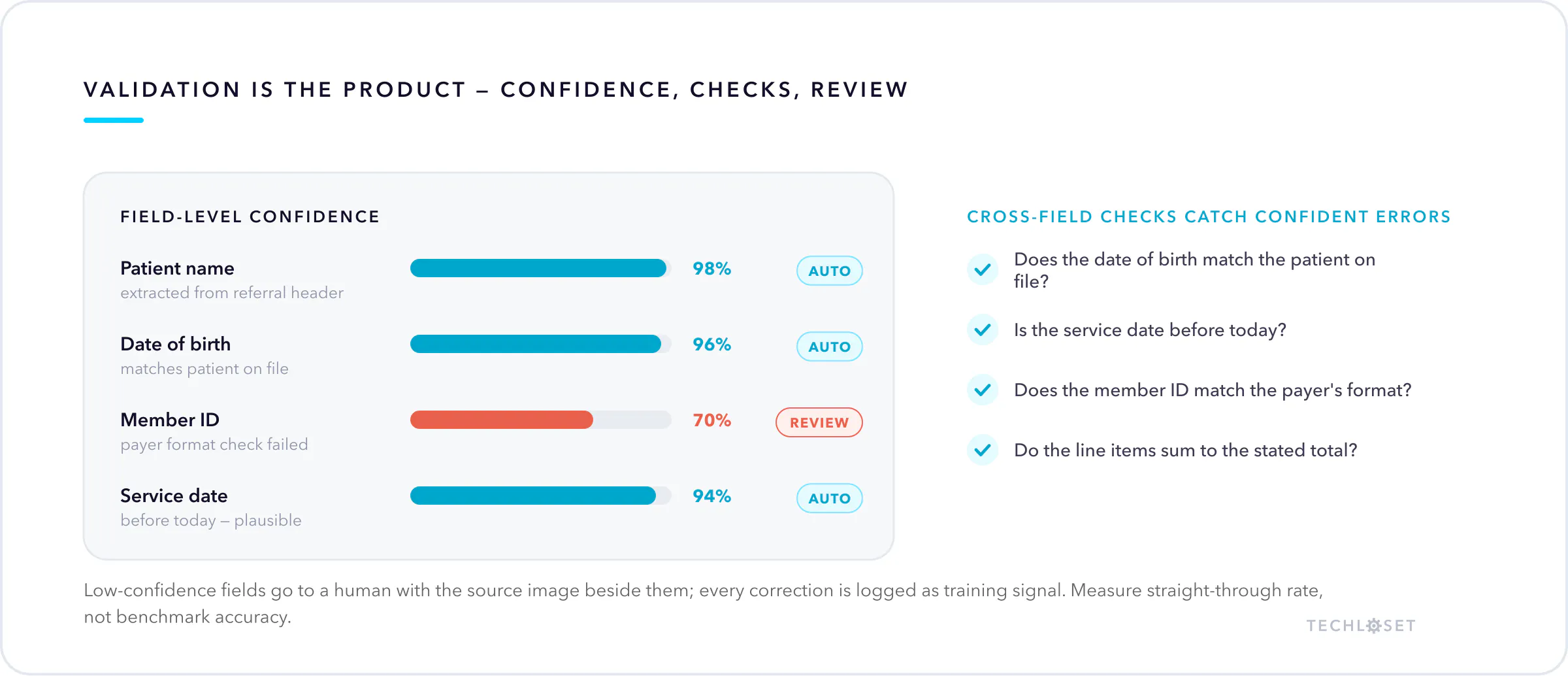
Field-level confidence, not document-level. A document is not 92% correct. Each field has its own confidence, and a member ID at 70% needs review even when the page average looks fine.
Cross-field checks catch what confidence misses. Does the date of birth match the patient on file? Is the service date before today? Does the member ID match the payer's format? Do the line items sum to the stated total? These rules catch confident errors, which are the dangerous ones.
A review queue is part of the design, not an admission of failure. Low-confidence fields go to a human with the source image beside the field, corrections take one keystroke, and every correction is logged as training signal.
Measure straight-through processing rate, not accuracy. The number that matters is: what share of documents cleared with no human touch and no downstream correction? That is the number that converts to hours saved. Accuracy on a benchmark set is a vanity metric.
Compliance, briefly but seriously
Every one of these documents is PHI, and so are the images. HIPAA applies to the whole path: encryption in transit and at rest, least-privilege access, audit logging of every extraction and every human view, retention policies with actual deletion, and a signed BAA with any vendor whose infrastructure touches a page — including OCR APIs and hosted model providers.
De-identify before sending anything to a general-purpose model endpoint, or use an endpoint covered by a BAA. "We only send it for a second" is not a control.
What to build first
Pick the single highest-volume document type and automate it end to end, including the review queue and the write-back. One document type fully working beats nine types half-working, because only the former removes labour from someone's day.
Then instrument it. You need per-field accuracy and straight-through rate from day one, because without them you cannot tell whether the second document type is going well or badly.
FAQ
Does it handle handwriting? Partially, and unreliably. Printed and typed text is solid; handwritten clinical notes remain hard. Assume handwriting goes to review.
Can it read faxes? Yes, and it must — fax is still a primary channel in US healthcare. Expect low resolution and skew, and preprocess accordingly.
How much training data do we need? For template-based extraction on a fixed layout, almost none. For model-based extraction, modern vision-language models work zero-shot on many document types, so start there and fine-tune only where results justify it.
How is this different from an AI scribe? Input. This turns files into records; a medical scribe turns conversation into records. Different failure modes, different validation, often the same destination system.
What about documents in other languages? OCR and extraction both degrade outside well-resourced languages. Validate per language; do not extrapolate.
Where we fit
We build document pipelines where being wrong has consequences — classification, OCR, model-based extraction, cross-field validation, a review queue clinicians will actually use, and FHIR/HL7 write-back into the systems you already run. The same interoperability bench behind our hospital platform.
If intake is eating hours or denials are tracking back to keying errors, book a call and bring a week of documents. We will tell you what clears automatically, what needs a human, and what the review queue realistically looks like.


