Habit apps mostly ask you to tick boxes. You tick them for eleven days, miss one, and stop opening the app. Nothing about the checkbox understood why you stopped.
An AI life coach app replaces the checkbox with a conversation — you say what you are trying to do, it asks the questions that make it concrete, and it checks in like something that remembers. The difference in format sounds cosmetic. It isn't, and it is worth understanding what conversation actually buys you, and the two places this category of product must not go.
What conversation is genuinely good at
Making a vague goal specific. "Get fitter" survives contact with nothing. Under a few questions — by when, how would you know, what would you do on Tuesday — it becomes something that either happens or doesn't. The value here is not AI insight; it is that being asked forces articulation, and articulation is most of goal-setting.
Reflection with a low barrier. Journaling works and almost nobody sustains it, because a blank page is intimidating. "How did today go?" is answerable in two sentences. A prompt that lowers the threshold gets you the practice that a blank page doesn't.
Non-judgemental accountability. The reason people avoid accountability partners is embarrassment about the fourth missed week. Software has no opinion of you, which turns out to matter — people report things to an app they would not admit to a friend, and reporting honestly is the point.
Noticing patterns across time. This is the genuinely hard thing humans cannot do for themselves. You do not remember that the last five times you skipped the gym, you had slept under six hours. A coach with your history can surface that, and a surfaced pattern is more useful than any amount of encouragement.
Being there at the moment it matters. Motivation collapses at 11pm on a Tuesday, not during a scheduled session. Availability is a real feature.
The two hard limits
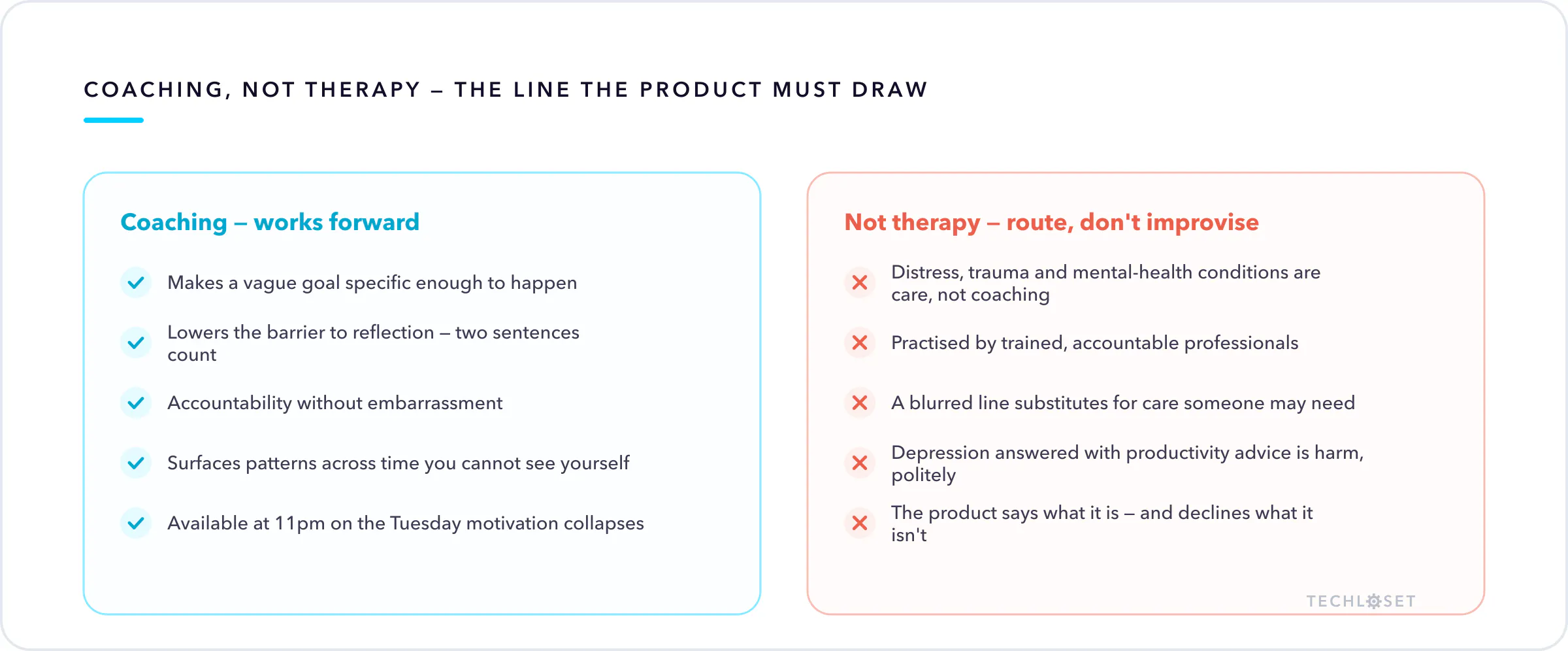
It is not therapy. This needs to be explicit in the product, not implied. Coaching works forward from a functioning baseline — goals, habits, structure. Therapy addresses distress, trauma, and mental health conditions, is practised by trained and accountable professionals, and is a different thing entirely. An app that blurs the two is doing something worse than overreaching: it is positioning itself as a substitute for care that a person may actually need, at the moment they are least able to judge the difference.
So it should say what it is, decline what it isn't, and route rather than improvise. A coaching app that responds to depression with productivity advice is causing harm politely.
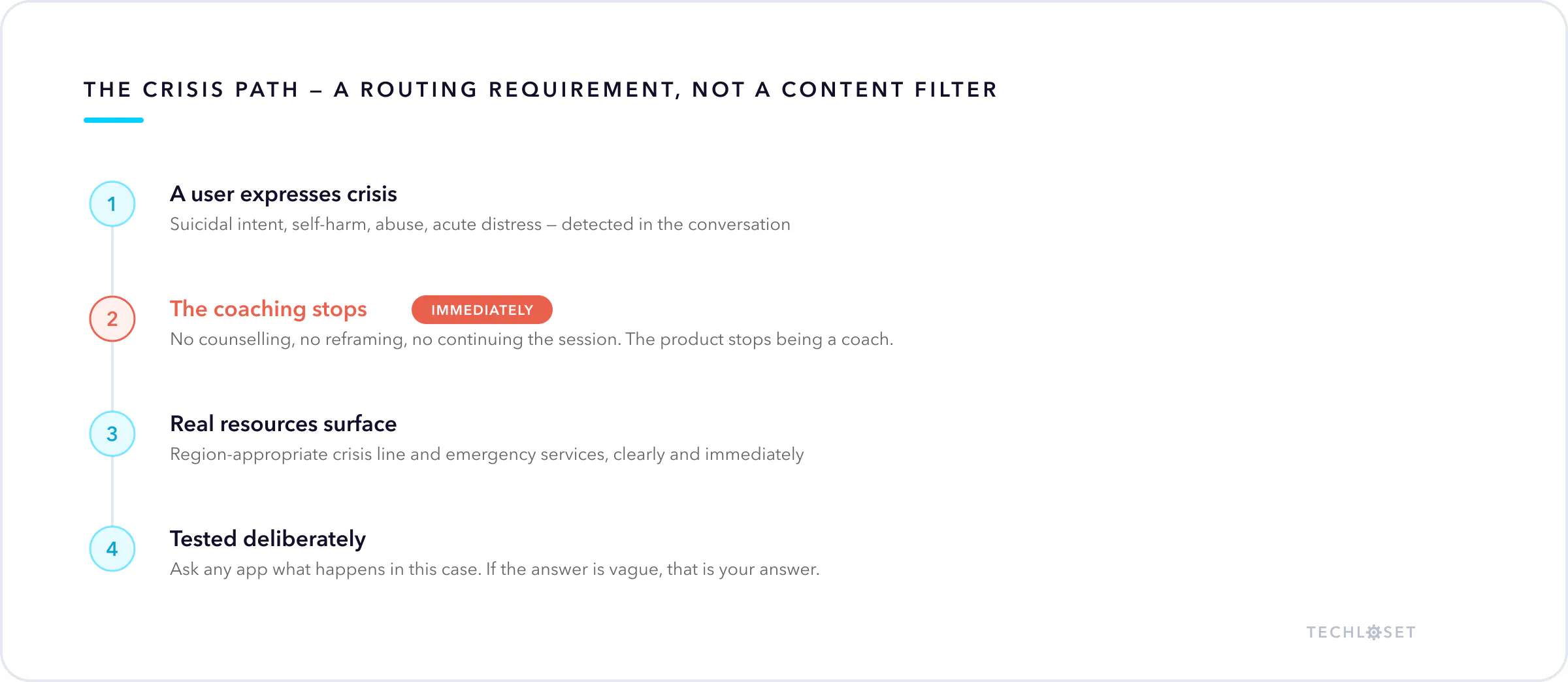
It must handle crisis properly. Non-negotiable, and the thing to check before trusting any app in this category. If a user expresses suicidal intent, self-harm, abuse, or acute crisis, the product stops being a coach. It surfaces real crisis resources — local emergency services, a crisis line for that user's country — clearly and immediately, and it does not attempt to counsel, reframe, or continue the coaching conversation.
This is not a content-filter problem to be handled with a refusal. It is a routing requirement, it needs region-appropriate resources, and it must be tested deliberately. Ask any app you are considering what happens in this case. If the answer is vague, that is your answer.
Memory is the product, and the privacy problem
A coach with no memory is a search box. Continuity is what makes coaching coaching — it knows your goal, remembers last week, and notices the pattern.
Which means it accumulates the most intimate dataset you will hand to an app: your goals, failures, relationships, self-assessments, and the things you write at midnight.
Reasonable questions to ask, and reasonable answers to want:
- Where is it stored, and is it encrypted at rest? Yes, it should be.
- Does a human ever read it? If support staff can, say so explicitly.
- Is it used to train models? If yes, that must be opt-in, not buried in a settings default.
- Can you export and delete everything? Both, actually working, without emailing support.
- What happens if the company is acquired or shuts down? Rarely answered, always worth asking.
Session-scoped memory is the privacy-safe default and produces weaker coaching. Persistent memory produces better coaching and a sensitive data store. That is a real trade-off, and a well-built app tells you which one you have rather than leaving you to guess.
What to look for in a good one
- It asks more than it advises. A coach that dispenses generic advice is a fortune cookie with a subscription.
- It handles the missed week without guilt-tripping. Streak-shaming is the main reason people abandon these apps.
- It works with small inputs. Two sentences should be enough. Anything requiring a structured daily entry gets abandoned in a busy week — exactly when you need it.
- It states its limits in the product, not only in the terms of service.
- It has a crisis path, and you can find it before you need it.
FAQ
Does an AI life coach work as well as a human one? Different strengths. Humans bring judgement, lived experience, and genuine relationship. Software brings availability, memory, consistency, and no social cost to admitting failure. For structure and habit formation, software competes well; for anything requiring wisdom about a specific life, it doesn't.
Is my data used to train the model? Depends on the app. It should be opt-in and clearly stated. Assume the worst if the policy is vague.
Can it help with anxiety or depression? It can support habits that help, like sleep and exercise routines. It is not treatment, and it should say so and point you to a professional. If an app claims otherwise, that claim is the problem.
What about children and teenagers? Different consent requirements, different safeguarding obligations, and stricter crisis handling. Most consumer coaching apps are not built for it and should say so.
Is this just a habit tracker with a chatbot? It is if the conversation has no memory and no pattern-recognition. The difference between the two is continuity — that is what to test in the first week.
The short version
An AI life coach earns its place on articulation, reflection, and remembering things about you that you don't. It has no business near therapy, and it must route crisis to real help rather than talking through it.
We build conversational products with those boundaries designed in from the start — scope limits, crisis routing, and an explicit decision about memory and the privacy cost that comes with it. Same discipline as coaching in the wellness space generally. If you are building here, book a call — the boundaries are the first thing worth designing, not the last.


