The reason most people stop doing yoga at home is not that their alignment was wrong. It is that nobody was expecting them at 7am, so Tuesday became Wednesday and Wednesday became next week.
That is the honest case for an AI yoga app: it is very good at the problem that actually stops people, and it has a hard limit that most marketing skips over. Worth knowing both before you decide whether one belongs in your practice.
What an AI coach genuinely does well
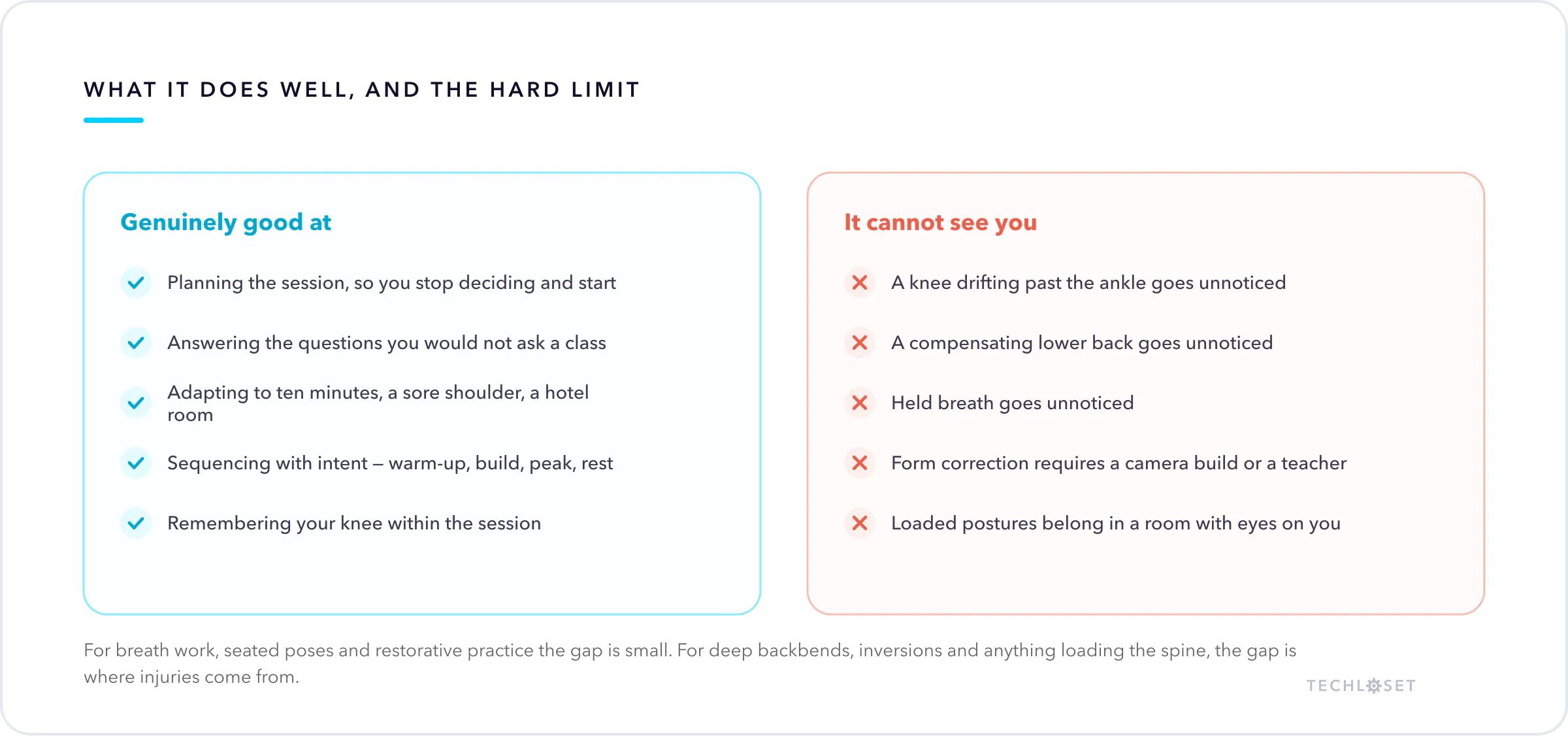
It plans, so you don't have to. Decision fatigue kills home practice — twenty minutes of scrolling for a video, then not doing it. A coach that knows your goal, your time, and what you did last session opens with "here's your 25 minutes" and removes the deciding.
It answers the questions you would not ask a class. Why does my wrist hurt in downward dog? What do I do instead of a headstand? Is it normal that one side is tighter? These are the questions that quietly stall beginners, because asking them in a room of strangers feels like admitting you don't belong. A chat coach has no social cost and infinite patience.
It adapts to constraints, not just goals. Ten minutes instead of forty. A sore shoulder. A hotel room. A rigid programme breaks on all three; a coach that can re-plan around them keeps the streak alive, and the streak is the whole outcome.
It sequences with intent. Yoga has real structure — warm-up, build, peak, counter-pose, rest. A coach that understands sequencing produces a session that makes anatomical sense rather than a shuffled playlist of poses.
It remembers within a session. Say your knee is bothering you and the rest of that conversation should account for it, without being told again.
The limit, stated plainly
A chat-based coach cannot see you.
It can describe how the pose should feel, tell you where your weight belongs, name the common mistakes, and cue the breath. It cannot tell you your knee has drifted past your ankle, or your lower back is compensating, or you are holding your breath. Those are the things an in-person teacher catches in two seconds from across the room.
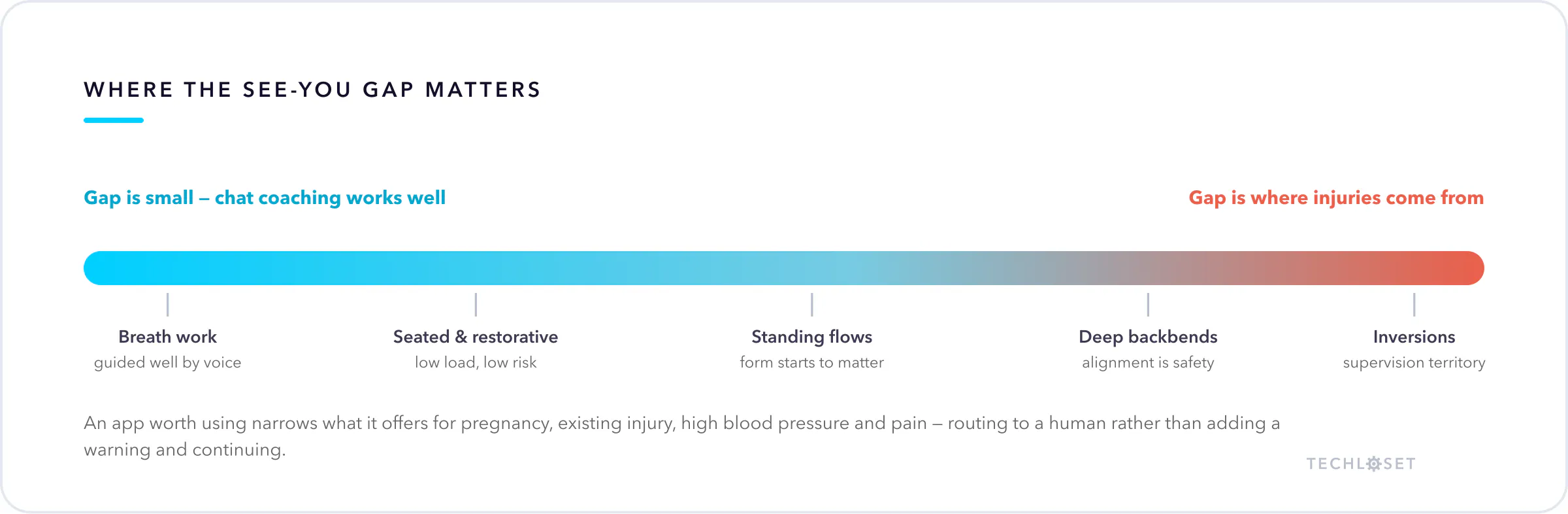
That distinction matters more in some poses than others. For breath work, seated poses, gentle flows and restorative practice, the gap is small. For deep backbends, inversions, and anything loading the neck, knees or lumbar spine, the gap is where injuries come from.
Camera-based pose detection is a different build — real, and technically closer to on-device vision work than to a chat coach. If an app advertises form correction, check whether it actually watches you or is only describing poses. Both are useful. They are not the same product, and only one can tell you that you are doing it wrong.
Where an app should send you to a human
Not a disclaimer — a routing decision the product should make:
- Pregnancy. Contraindications are specific and change by trimester.
- Existing injury, particularly spine, knee, shoulder or wrist.
- High blood pressure, glaucoma, recent surgery. Inversions and some breath practices are genuinely contraindicated.
- Pain, as opposed to effort. Sharp, radiating, or joint pain means stop and ask a clinician. Any app that treats pain as something to breathe through is badly designed.
- Inversions and deep backbends generally, for beginners without supervision.
An app worth using narrows what it offers in these cases rather than adding a warning and continuing.
The parts that are not AI
Worth saying, because the AI gets the attention and the rest does the work:
- Video sessions, because reading a pose description is not learning a pose. The coach plans; the video teaches.
- Tracking, because visible consistency is self-reinforcing. Streaks work.
- A community, because accountability from other people outperforms accountability from software. This is consistently the most underrated feature in wellness apps.
- A profile that persists, so the coaching is cumulative rather than starting fresh each time.
Who it fits
Beginners, strongly — the questions get answered without embarrassment and the sequencing is handled.
Busy professionals, strongly — the adaptation to whatever time exists today is the feature that makes practice survive a bad week.
People practising for stress and anxiety, well — breath-led and restorative practice is exactly where the see-you gap is smallest.
Intermediate practitioners, partially — useful for planning and variety, insufficient for progressing into advanced postures, where you want eyes on you.
Anyone rehabilitating an injury — not without a clinician directing it. Yoga is often part of rehab, and which part is a clinical decision.
FAQ
Can it replace a teacher? For consistency, planning, and answering questions, it substitutes well. For alignment, safety in loaded poses, and hands-on adjustment, no. Many people do best with an app most days and a real class occasionally.
Is it safe for a complete beginner? For gentle and foundational practice, generally yes, provided the app declines to push you into advanced postures and routes health conditions to a professional.
Does it give medical advice? It should not, and a well-built one is explicit about that. Yoga apps sit adjacent to health without being healthcare, and that boundary needs stating in the product.
What about the chat remembering everything? Session-scoped memory is the common design and it is a reasonable privacy default. Persistent memory across sessions makes coaching better and turns your practice history into stored personal data — a real trade-off, and you should be told which one you are getting.
The short version
An AI yoga app solves the problem that actually stops people, which is showing up. It cannot see your alignment, so treat its guidance as a plan and a conversation rather than a correction, keep loaded postures for a room with a teacher in it, and let it route you to a human when your body gives it a reason to.
We build coaching products with the scope limits designed in — what the AI plans, what a video teaches, and where it hands off to a professional. Same pattern as conversational coaching more broadly. If you are building in this space, book a call and bring your safety boundaries; that is the conversation worth having first.


