Two minutes, twice a day. Every parent knows the number, and every parent knows what actually happens: forty seconds of enthusiastic scrubbing on the same four front teeth, then a declaration of completion.
A two-minute timer does not fix this, because the timer measures elapsed time, not brushing. It runs happily while the toothbrush sits on the sink.
The interesting version of a kids teeth brushing app watches. It uses the front camera to work out which section of the mouth is actually being brushed, and the timer only advances when the child is brushing a section that still needs it. And — this is the part worth the article — the camera feed never leaves the phone.
How it works
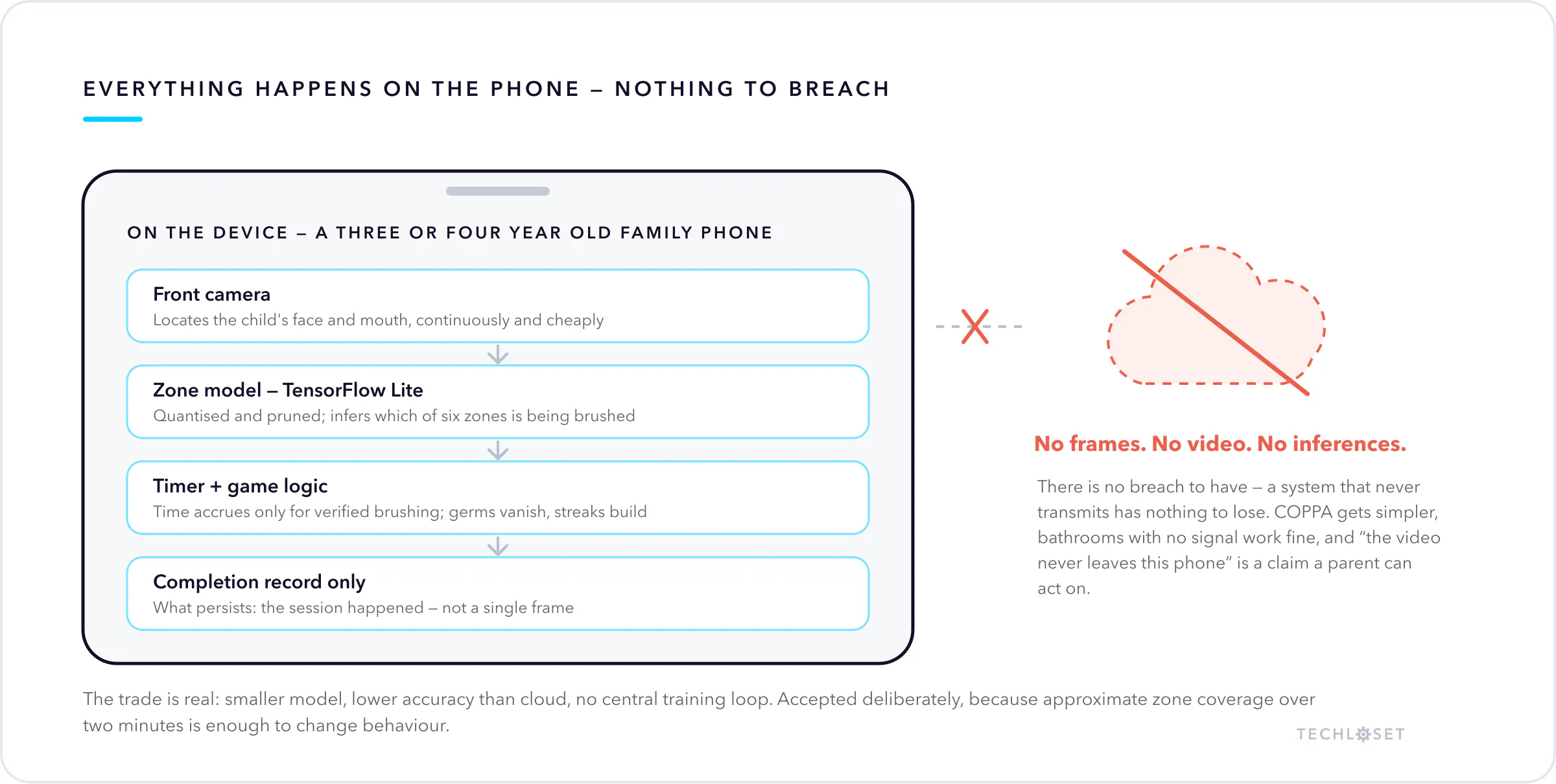
Face and mouth tracking. The front camera locates the child's face and mouth position. This runs continuously and cheaply, and it is also how the app knows whether the child is still there.
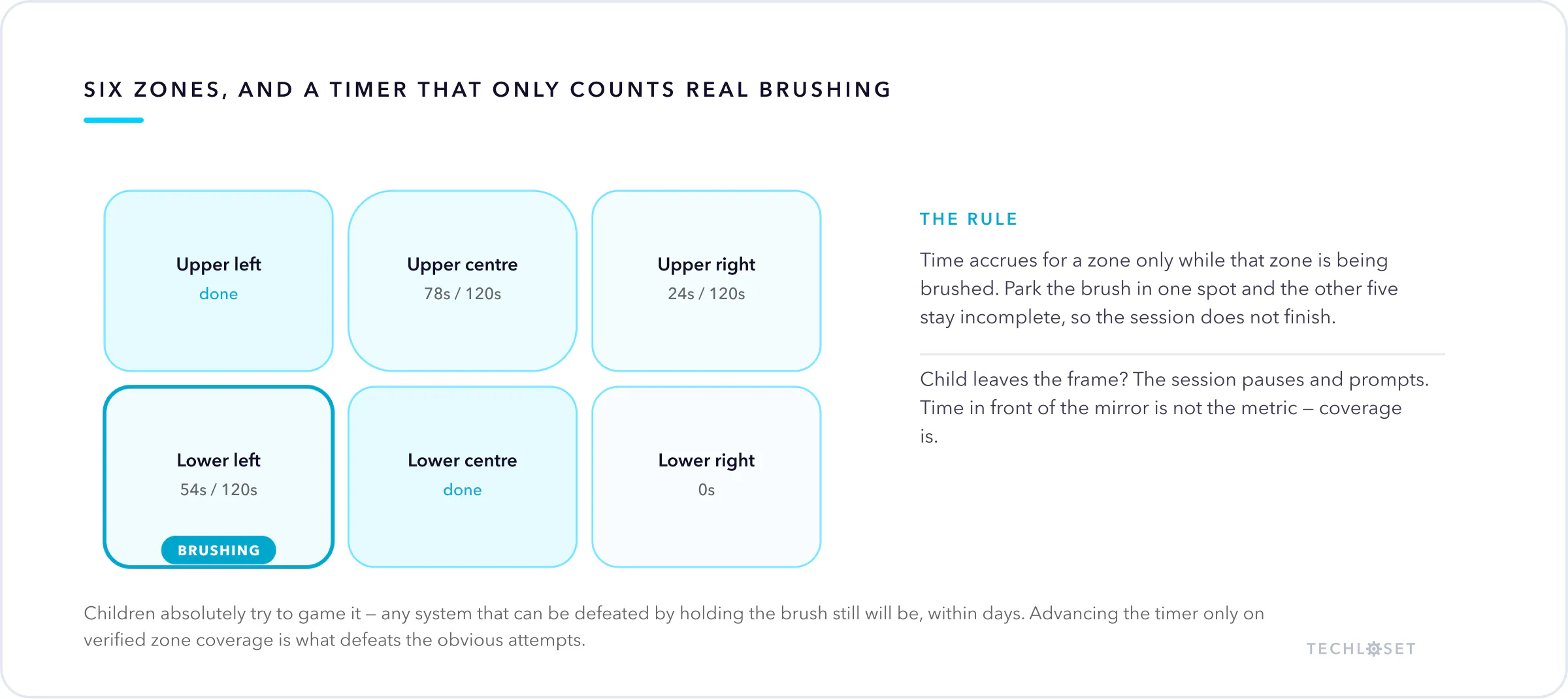
Zone detection. The mouth divides into six zones — upper and lower, left, centre and right. A small vision model, running in TensorFlow Lite on the device, infers which zone the brush is currently working. Not perfectly, and it does not need to be: the goal is coverage over two minutes, not per-stroke precision.
A timer that only counts real brushing. The critical design choice. Time accrues for a zone only while that zone is being brushed. Park the brush in one spot and the other five zones stay incomplete, so the session does not finish. This is what makes the app resistant to being gamed by a seven-year-old, and children absolutely try — any system that can be defeated by holding the brush still will be, within days.
Pause and prompt on drift. Child leaves the frame, gets distracted, wanders off: the session pauses and prompts rather than running down. Time in front of the mirror is not the metric. Coverage is.
Why gamification is the actual mechanism
The vision model makes verification possible. It does not make a child want to brush. That is a separate design problem, and it is where these apps succeed or get deleted.
Germs that disappear as a zone gets cleaned. This is the strongest single element, because it turns an abstract instruction into visible cause and effect. The child can see the back-left molars still have work.
A progress map with checkpoints, so the session has structure and a visible end rather than being an undifferentiated two minutes.
Badges and streaks for the days beyond the first novelty week — which is where every kids app either forms a habit or loses.
Confetti at the end. Small, and it matters. A session that completes with nothing feels like a chore that ended. A session that completes with a celebration is a thing worth doing tomorrow.
The behavioural logic underneath: immediate feedback beats delayed consequence. "Cavities in three years" is meaningless to a child. "This germ vanished when you brushed here" is immediate, legible, and repeatable.
The privacy architecture, which is the real story
Point a camera at a child's face and you have created the most sensitive data-collection scenario in consumer software. The engineering answer here is the one that should be standard and isn't: nothing is uploaded. No frames, no video, no images, no inferences. Processing happens entirely on the device.
Why that matters concretely:
- There is no breach to have. A cloud service holding video of children is a target and an eventual incident. A system that never transmits has nothing to lose.
- COPPA and equivalents get far simpler. Children's privacy regulation is strict about collecting personal information from under-13s. Not collecting it is the cleanest compliance posture available.
- Parental trust is the buying decision. Parents are, correctly, suspicious of camera access. "The video never leaves this phone" is a claim they can act on. "We take privacy seriously" is not.
- It works offline. Bathrooms have poor signal. On-device inference does not care.
Local processing is not a feature to list beside others. In a product like this, it is the precondition for the product being acceptable at all.
The engineering trade-offs, honestly
On-device inference costs something, and pretending otherwise would be dishonest:
- The model must be small. Quantised, pruned, and much lighter than a server-side equivalent. Accuracy per parameter matters more than raw accuracy.
- Older devices are the constraint. Family phones are frequently three or four years old. The target is the oldest device you intend to support, not the newest.
- Battery and thermals. Continuous camera plus inference is expensive. Two minutes is a manageable budget; frame rate and resolution tuning are where it is won.
- Accuracy is lower than cloud would give. Accepted deliberately, because the task tolerates it — approximate zone coverage over two minutes is enough to change behaviour.
- No central training loop. You cannot learn from user data you never collect. Improvement comes from your own labelled datasets, which is slower and is the price of the privacy claim.
What to ask of any kids app that wants camera access
A short checklist, useful beyond this category:
- Does video or imagery leave the device? If yes, stop and read carefully.
- What is retained after a session? Ideally nothing but a completion record.
- Is there an account, and does it need one? Fewer identifiers, less exposure.
- Are there ads or third-party SDKs? Ad networks in children's apps are how data escapes a product that otherwise looked clean.
- What does it do with no connection? An app that works offline is an app that isn't phoning home.
FAQ
Does it actually improve brushing? It improves coverage and duration, which are the two mechanically controllable inputs to brushing quality. It cannot assess technique or pressure, and it is not a substitute for a dentist.
What age is it for? Roughly the years where children brush independently but not thoroughly — about four to ten. Younger children need a parent brushing for them, and the app should say so rather than implying supervision is optional.
Does it need a special toothbrush? No. That is the advantage of the camera-based approach over smart-brush hardware: it works with the brush already in the bathroom.
Will children game it? They will try. Advancing the timer only on verified zone coverage is what defeats the obvious attempts, and worth testing with actual children, who are more inventive than adult testers.
Could this work for adults? Yes, and it matters less — adults mostly know how to brush and choose not to for long enough. The gamification is what makes it work for children.
Where we fit
We build on-device AI where privacy is a product requirement rather than a policy page — TensorFlow Lite models sized for real family hardware, camera pipelines that never transmit, and gamification designed around how children actually behave. The contrast with chat-based coaching is here.
If you are building a kids product with a camera in it, book a call. The first conversation is about what you can avoid collecting.


