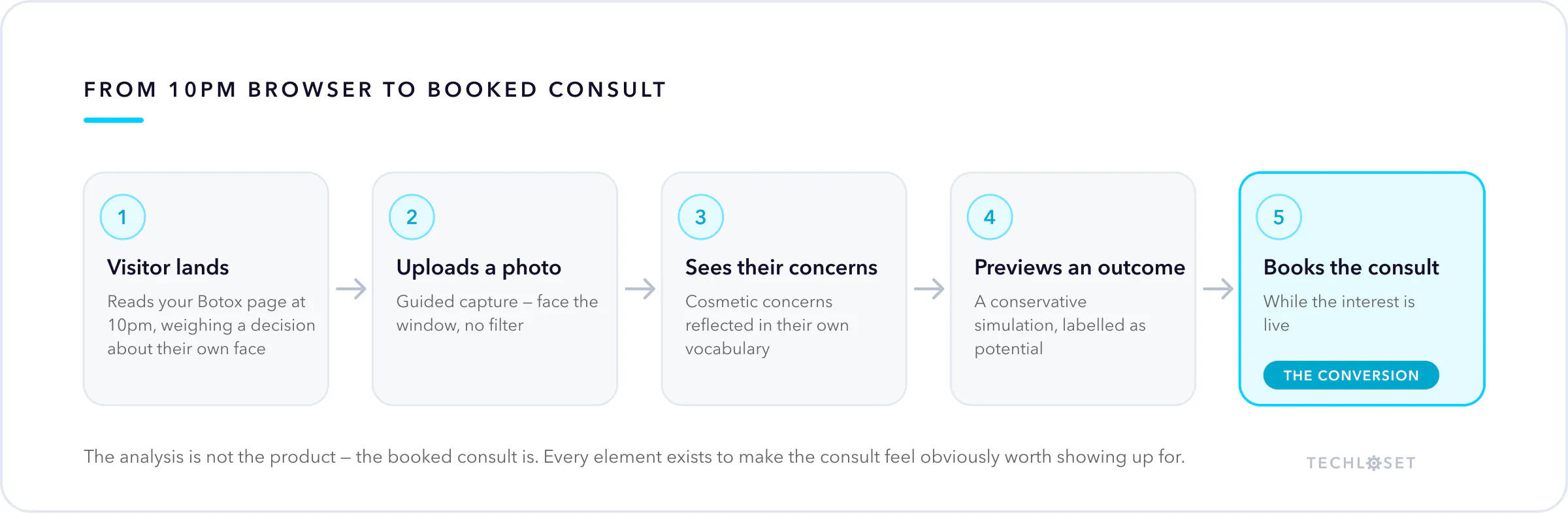
Someone lands on your site at 10pm, reads your Botox page, looks at your before-and-afters, and leaves. They were interested. They are also weighing a few hundred to a few thousand dollars on a decision about their own face, and no page of text closes that.
What they actually want to know is not on your site: what would this do for me?
AI skin analysis answers that question at the moment they are asking it. A visitor uploads a photo, sees their own visible concerns reflected back, previews a simulation of a potential outcome, and books a consult while the interest is live. The consult is the conversion. The analysis is what gets them to it.
Why aesthetic buying stalls
High-consideration, self-image-linked, cash-pay purchases fail at the same point every time: uncertainty about personal relevance.
Your before-and-after gallery shows strangers. Your treatment page describes a mechanism. Neither tells this person, with this skin, at this age, what changes. So they save the tab and research for three weeks, and somewhere in that gap they book with whoever gave them a reason to feel confident first.
That gap is where the revenue leaks, and it leaks silently — no missed call, no cancelled appointment, nothing in your reporting. Just traffic that arrived interested and left uncommitted.
What the tool does, and what it must never do
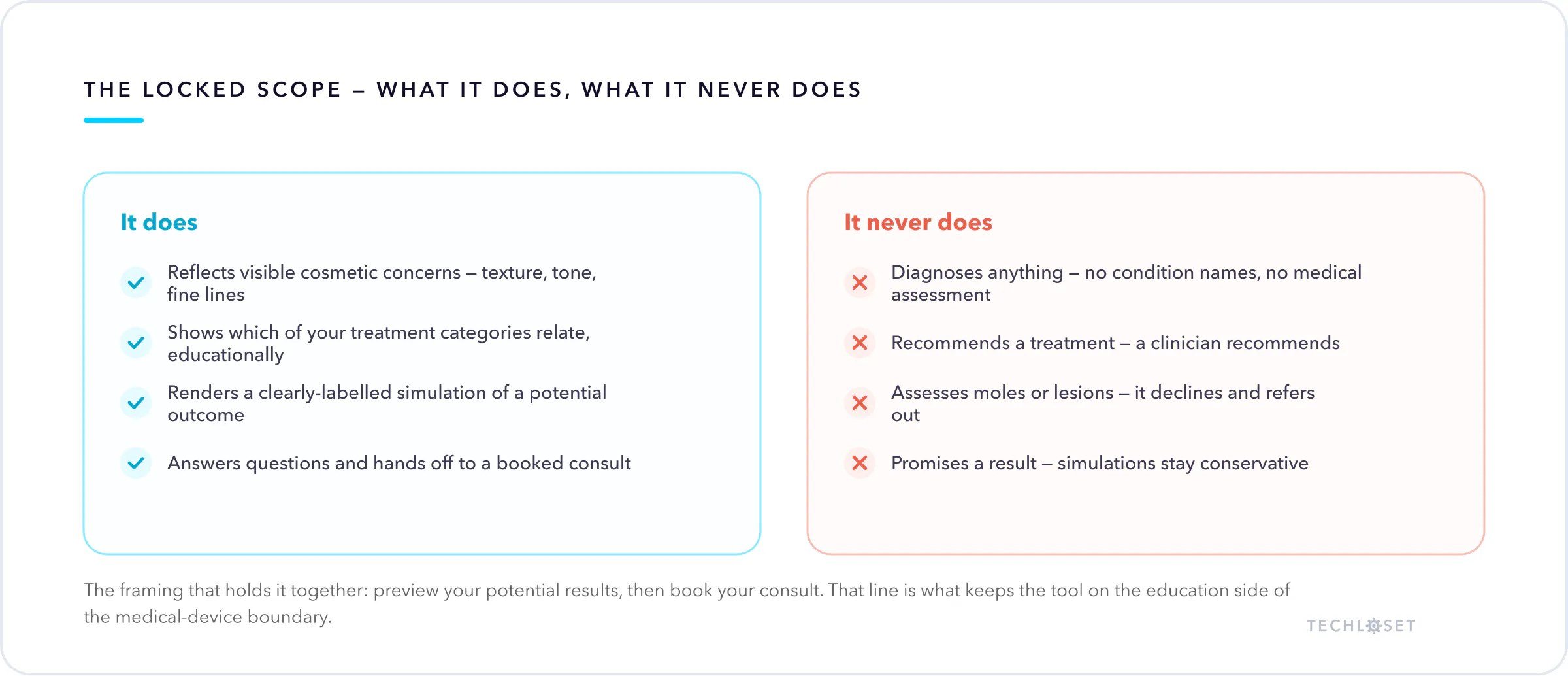
It does:
- Let a visitor upload a photo of their face, or the area they are concerned about.
- Reflect back the cosmetic concerns visible in it — texture, uneven tone and pigmentation, fine lines, the appearance of acne or scarring, laxity. The vocabulary the patient already uses about themselves.
- Show which of your treatment categories relate to those concerns, educationally.
- Render a simulation of a potential outcome — the piece that makes the decision feel concrete.
- Answer questions conversationally: what the treatment involves, downtime, what to expect at a consult.
- Hand off to a booked consult.
It never:
- Diagnoses anything. No condition names, no medical assessment.
- Recommends a treatment. It shows options relevant to a cosmetic concern and lets a clinician recommend. The distinction is not cosmetic — it is the line between an education tool and a medical device claim.
- Assesses moles, lesions, or anything that could be a skin cancer. This one is absolute. If a user uploads a photo focused on a lesion, the correct product behaviour is to decline the analysis and tell them to see a dermatologist. Not analyse it with a disclaimer. Decline it.
- Promises a result. Simulations show a potential outcome, labelled as such, and are tuned conservatively.
The framing that holds all of this together, and the one to use in your own copy: preview your potential results, then book your consult.
The narrow framing is also the better sales pitch
Clinic owners sometimes want it to do more, so it is worth saying why less converts better.
A tool that appears to diagnose and prescribe positions itself as an alternative to your expertise — and then a patient arrives having decided what they want, which is a harder consult, not an easier one. A tool that shows possibility and routes to a professional positions your clinician as the authority and the consult as the necessary next step.
You are not selling self-service aesthetics. You are selling a booked consult with a specialist. The software's job is to make that consult feel obviously worth showing up for.
It also keeps you clear of a regulatory category you do not want to enter. Same demo, safe claim.
What actually decides whether it converts
Photo quality handling. Real uploads are badly lit selfies at odd angles. Guide the capture — face the window, hold still, no filter — and decline gracefully when an image is unusable rather than analysing it badly. A wrong analysis from a dark photo costs you the trust you were building.
Conservative simulations. The strongest temptation and the biggest risk. An oversold simulation converts a booking and loses the patient at the consult when your clinician has to walk it back — or worse, after treatment. Under-promise slightly. The credibility compounds; the disappointment compounds faster.
Consent, explicit and upfront. A facial photograph is biometric and personally identifiable. Say what happens to it, whether it is stored, for how long, and get real consent. Default to not retaining images beyond the session unless the patient chooses to save them for their consult.
One CTA. Book the consult. Not a newsletter, not a quiz, not a download. Every additional option lowers the one that matters.
Follow-up when they don't book. An engaged visitor who did not book is your warmest lead of the week. With consent, that is a message worth sending — and it is the same front-desk plumbing as answering the calls you are missing.
FAQ
Does this replace the consultation? The opposite — it exists to fill consultations. It shows possibility; a clinician assesses, recommends and treats.
Is it regulated as a medical device? Scoped as described here — cosmetic concerns, education, visualisation, explicitly not diagnosis or treatment recommendation — it stays on the education side. Cross into diagnosis or treatment recommendation and the answer changes. That is precisely why the scope is drawn where it is.
What about patient photos and privacy? Facial images are sensitive personal data. Minimise retention, encrypt what you keep, get explicit consent, and be prepared to delete on request. If anything clinical enters the flow, HIPAA obligations follow.
How accurate are the simulations? They are illustrative, not predictive, and should be labelled that way in the interface. Accuracy is less important than honesty — a clearly-labelled conservative preview builds trust; a photorealistic promise creates a complaint.
Where does it go on my site? On treatment pages, where the interest is already specific, and as an entry point from social — the visual output is the most shareable asset in this category.
Where to start
The tool is one part of a bigger question: where is your clinic losing patients who were already interested? Sometimes it is the 10pm browser with no way to picture the outcome. Often it is also the call nobody answered, the DM that sat unread for six hours, or the patient who has not been back in five months and was never asked.
That is what our AI Revenue Recovery Audit measures — $2,500, credited in full against the build if you go ahead. We mystery-shop your front desk, map where interested patients drop out, and size what closing each gap is worth before you commit to anything.
Book the audit. You get the numbers either way.


