Your patients did not download your app and will not check the portal. They are, however, in WhatsApp several times an hour.
That is the entire argument for WhatsApp appointment booking: meet people on the channel they already read, instead of the one you wish they used. Booking, rescheduling and reminders all happen in a thread they never have to log into. Done properly it cuts no-shows and takes the phone off your front desk. Done carelessly it creates a privacy problem and a pile of un-deliverable messages.
Both parts below.
Why the channel wins
Email reminders get filtered and ignored. SMS gets read but is one-way in practice — a patient who needs to move an appointment still has to call. Phone calls need somebody free to answer, which during treatment hours nobody is.
WhatsApp is read, and it is conversational. A patient can reply "can we do Thursday instead" without a call, and get it done. The reschedule that would otherwise have become a no-show becomes a moved booking, which is the whole game — an empty chair earns nothing, and a moved appointment earns full price.
What patients can do in the thread
Book. Ask for a service, see real availability, pick a slot, get a confirmation. Availability must come live from the calendar — a bot offering slots that were taken an hour ago is worse than no bot.
Reschedule and cancel. The highest-value interaction, because it converts a silent no-show into a filled slot. Make it one message, and never route it through a phone call.
Register. New patients supply the details that would otherwise be captured on a clipboard. Collect the minimum and see the privacy section first.
Get reminders. Automated, timed, on a channel people actually read. This is where the no-show reduction comes from.
Reach a human. Always. Any conversation that stalls, or where the patient asks twice, hands off to staff with the full thread visible. A bot with no exit is a complaint generator.
The admin side
The patient-facing thread is the visible half. The half that decides whether staff adopt it:
- Doctor and provider management — who works when, which services they deliver, how long each takes.
- Schedule management — real availability, blocked time, buffers, room and equipment constraints. Most booking failures are calendar-modelling failures, not AI failures.
- Patient records — history, contact details, prior visits.
- One calendar, not two. If WhatsApp bookings land somewhere staff must reconcile by hand, you have added work. It writes into the system your front desk already uses, or it does not ship.
The WhatsApp Business API rules you have to design around
This is the part that surprises teams mid-build. WhatsApp is not an open SMS pipe.
You need the Business API, via Meta or a provider. The consumer app and WhatsApp Business app will not do this. Access is through the Cloud API or a business solution provider.
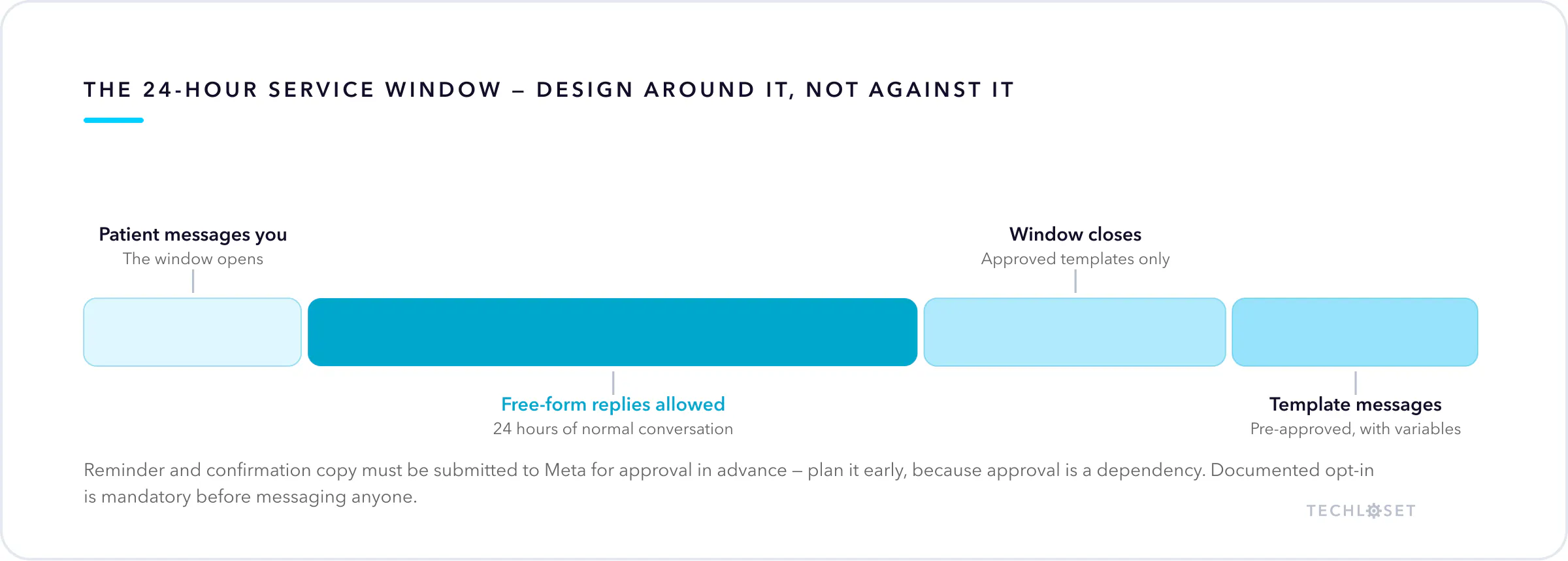
Outbound messages need pre-approved templates. You cannot send arbitrary text to a patient who has not messaged you recently. Reminder and confirmation content is submitted for approval in advance, with variable placeholders. Plan your reminder copy early, because approval is a dependency, not a formality.
There is a 24-hour service window. Once a patient messages you, free-form replies are allowed for 24 hours. Outside it, templates only. This shapes your whole reminder architecture.
Opt-in is mandatory. You need documented consent before messaging a patient. Capture it at registration, record when and how, and honour opt-out immediately.
Messages cost money. Pricing is per message or per conversation depending on category and country. At clinic volumes it is small, but model it — an over-eager reminder schedule is a line item.
The privacy limit — read this before building
WhatsApp messages are end-to-end encrypted in transit, and that is genuinely good. It does not make the channel HIPAA-compliant for clinical content.
Meta does not sign a BAA for WhatsApp. Message content and metadata pass through infrastructure you have no agreement covering, and it lands on a patient's phone with whatever lock screen and shared device situation exists there. For US covered entities, that rules out clinical detail in the thread.
The workable design keeps the channel administrative:
- Fine: appointment date and time, provider name, location, "reply to reschedule", generic service categories.
- Not fine: diagnoses, test results, treatment specifics, clinical notes, anything a reasonable person would call medical information.
- For anything clinical: send a link into an authenticated portal and let the patient authenticate there. The notification is on WhatsApp; the content is not.
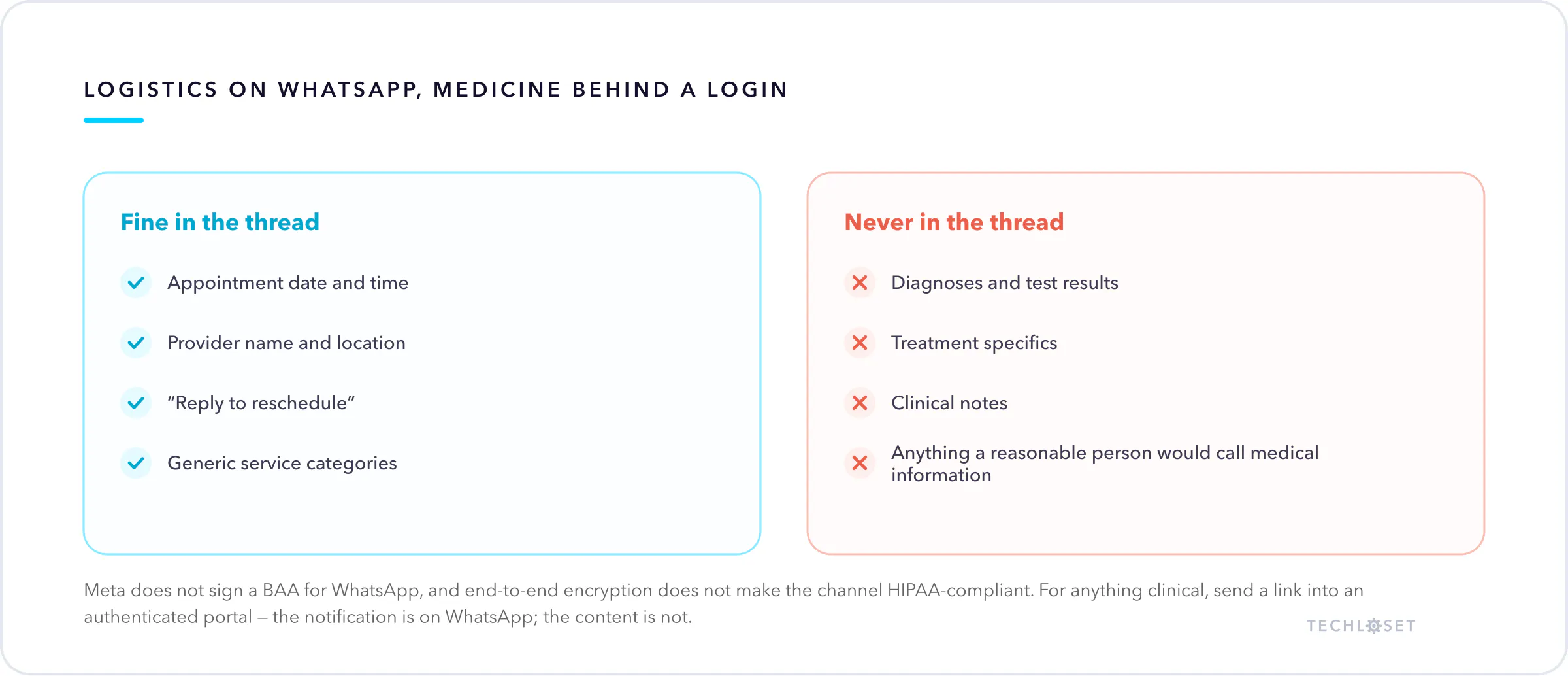
Outside the US, check your own regime — GDPR consent and data-processing obligations apply in the EU, and local health-data rules vary. The general principle holds everywhere: logistics on WhatsApp, medicine behind a login.
FAQ
Will this actually cut no-shows? Reminders on a read channel plus one-message rescheduling address the two real causes: forgetting, and it being easier to skip than to call. Measure your own baseline before and after rather than trusting a vendor's number.
Do we need a chatbot, or will a human do? Start with a human handling the thread and automate what repeats. Most clinics find the same handful of requests dominate, and those are worth automating precisely.
What about patients who prefer to call? Keep the phone line. Channels add, they do not replace — the inbound-call version is here.
Can it assess symptoms? Keep that separate and deliberate. Triage is its own problem with its own safety requirements, and it does not belong bolted onto a booking bot.
How long to launch? The bot is quick. Business API access, template approval and calendar integration set the timeline.
Where to start
One service, one provider, one calendar. Reminders and rescheduling first, because that is where the recovered revenue is, and booking second. Get consent capture and the human handoff right on day one — those are the two things that turn a helpful channel into a complaint.
We build this as one piece of a front desk that covers every channel — the same engine behind our AI receptionist work. If patients are messaging you and nobody is answering fast enough, book a call and we will map which requests to automate first.


